The Linkielist

Linking ideas with the world

The Linkielist

Privacy watchdogs from the UK, Australia team up, snap on gloves to probe AI-for-cops creeeps Clearview

Following Canada’s lead earlier this week, privacy watchdogs in Britain and Australia today launched a joint investigation into how Clearview AI harvests and uses billions of images it scraped from the internet to train its facial-recognition algorithms.

The startup boasted it had collected a database packed with more than three billion photos downloaded from people’s public social media pages. That data helped train its facial-recognition software, which was then sold to law enforcement as a tool to identify potential suspects.

Cops can feed a snapshot of someone taken from, say, CCTV footage into Clearview’s software, which then attempts to identify the person by matching it up with images in its database. If there’s a positive match, the software links to that person’s relevant profiles on social media that may reveal personal details such as their name or where they live. It’s a way to translate previously unseen photos of someone’s face into an online handle so that person can be tracked down.

Now, the UK’s Information Commissioner (ICO) and the Office of the Australian Information Commissioner (OAIC) are collaborating to examine the New York-based upstart’s practices. The investigation will focus “on the company’s use of ‘scraped’ data and biometrics of individuals,” the ICO said in a statement.

“The investigation highlights the importance of enforcement cooperation in protecting the personal information of Australian and UK citizens in a globalised data environment,” it added. “No further comment will be made while the investigation is ongoing.”

Source: Privacy watchdogs from the UK, Australia team up, snap on gloves to probe AI-for-cops upstart Clearview • The Register

Detroit cops employed facial recognition algos that only misidentifies suspects 96 per cent of the time

Cops in Detroit have admitted using facial-recognition technology that fails to accurately identify potential suspects a whopping 96 per cent of the time.

The revelation was made by the American police force’s chief James Craig during a public hearing, this week. Craig was grilled over the wrongful arrest of Robert Williams, who was mistaken as a shoplifter by facial-recognition software used by officers.

“If we would use the software only [to identify subjects], we would not solve the case 95-97 per cent of the time,” Craig said, Vice first reported. “That’s if we relied totally on the software, which would be against our current policy … If we were just to use the technology by itself, to identify someone, I would say 96 per cent of the time it would misidentify.”

The software was developed by DataWorks Plus, a biometric technology biz based in South Carolina. Multiple studies have demonstrated facial-recognition algorithms often struggle with identifying women and people with darker skin compared to Caucasian men.

Source: Detroit cops employed facial recognition algos that only misidentifies suspects 96 per cent of the time • The Register

New mathematical idea reins in AI bias towards making unethical and costly commercial choices

Researchers from the University of Warwick, Imperial College London, EPFL (Lausanne) and Sciteb Ltd have found a mathematical means of helping regulators and business manage and police Artificial Intelligence systems’ biases towards making unethical, and potentially very costly and damaging commercial choices—an ethical eye on AI.

Artificial intelligence (AI) is increasingly deployed in commercial situations. Consider for example using AI to set prices of insurance products to be sold to a particular customer. There are legitimate reasons for setting different prices for different people, but it may also be profitable to ‘game’ their psychology or willingness to shop around.

The AI has a vast number of potential strategies to choose from, but some are unethical and will incur not just moral cost but a significant potential economic penalty as stakeholders will apply some penalty if they find that such a strategy has been used—regulators may levy significant fines of billions of Dollars, Pounds or Euros and customers may boycott you—or both.

So in an environment in which decisions are increasingly made without , there is therefore a very strong incentive to know under what circumstances AI systems might adopt an unethical strategy and reduce that risk or eliminate entirely if possible.

Mathematicians and statisticians from University of Warwick, Imperial, EPFL and Sciteb Ltd have come together to help business and regulators creating a new “Unethical Optimization Principle” and provide a simple formula to estimate its impact. They have laid out the full details in a paper bearing the name “An unethical optimization principle”, published in Royal Society Open Science on Wednesday 1st July 2020.

The four authors of the paper are Nicholas Beale of Sciteb Ltd; Heather Battey of the Department of Mathematics, Imperial College London; Anthony C. Davison of the Institute of Mathematics, Ecole Polytechnique Fédérale de Lausanne; and Professor Robert MacKay of the Mathematics Institute of the University of Warwick.

Professor Robert MacKay of the Mathematics Institute of the University of Warwick said:

“Our suggested ‘Unethical Optimization Principle’ can be used to help regulators, compliance staff and others to find problematic strategies that might be hidden in a large strategy space. Optimisation can be expected to choose disproportionately many unethical strategies, inspection of which should show where problems are likely to arise and thus suggest how the AI search algorithm should be modified to avoid them in future.

“The Principle also suggests that it may be necessary to re-think the way AI operates in very large spaces, so that unethical outcomes are explicitly rejected in the optimization/learning process.”


Explore further

COVID-19 vaccine development: New guidelines for ethical approach to infecting trial volunteers


More information: An Unethical Optimization Principle, Royal Society Open Science (2020). URL after publication: royalsocietypublishing.org/doi/10.1098/rsos.200462

Source: New mathematical idea reins in AI bias towards making unethical and costly commercial choices

Burger King Is Leveraging Tesla Autopilot’s Confusion To Sell Whoppers

the Monarch of Meat announced a campaign that takes advantage of some sloppy sign recognition in the Tesla Autopilot’s Traffic Light and Stop Sign control, specifically in instances where the Tesla confuses a Burger King sign for a stop sign (maybe a “traffic control” sign?) and proceeds to stop the car, leaving the occupants of the car in a great position to consume some Whoppers.

The confusion was first noted by a Tesla Model 3 owner who has confusingly sawed the top off his steering wheel, for some reason, and uploaded a video of the car confusing the Burger King sign for a stop sign.

Burger King’s crack marketing team managed to arrange to use the video in this ad, and built a short promotion around it:

Did you see what I was talking about with that steering wheel? I guess the owner just thought it looked Batmobile-cool, or something? It’s also worth noting that is seems that the car’s map display has been modified, likely to remove any Tesla branding and obscure the actual location:

Illustration for article titled Burger King Is Leveraging Tesla Autopilots Confusion To Sell Whoppers

The promotion, which Burger King is using the #autopilotwhopper hashtag to promote, was only good for June 23rd, when they’d give you a free Whopper if you met the following conditions:

To qualify for the Promotion, guest must share a picture or video on Twitter, Facebook or Twitter with guest’s smart car outside a BK restaurant using #autopilotwhopper and #freewhopper.

Guests who complete step #3 will receive a direct message, within 24 hours of posting the picture/video, with a unique code for a Free Whopper sandwich (“Coupon”). Limit one Coupon per account.

It seems Burger King is using the phrase “smart car” to refer to any car that has some sort of Level 2 semi-autonomous driver’s assistance system that can identify signs, but the use of the “autopilot” in the hashtag and the original video make it clear that Teslas are the targeted cars here.

Source: Burger King Is Leveraging Tesla Autopilot’s Confusion To Sell Whoppers

How to jam neural networks

Sponge Examples: Energy-Latency Attacks on Neural Networks shows how to find adversarial examples that cause a DNN to burn more energy, take more time, or both. They affect a wide range of DNN applications, from image recognition to natural language processing (NLP). Adversaries might use these examples for all sorts of mischief – from draining mobile phone batteries, though degrading the machine-vision systems on which self-driving cars rely, to jamming cognitive radar.

So far, our most spectacular results are against NLP systems. By feeding them confusing inputs we can slow them down over 100 times. There are already examples in the real world where people pause or stumble when asked hard questions but we now have a dependable method for generating such examples automatically and at scale. We can also neutralize the performance improvements of accelerators for computer vision tasks, and make them operate on their worst case performance.

One implication is that engineers designing real-time systems that use machine learning will have to pay more attention to worst-case behaviour; another is that when custom chips used to accelerate neural network computations use optimisations that increase the gap between worst-case and average-case outcomes, you’d better pay even more attention.

Source: How to jam neural networks | Light Blue Touchpaper

OpenAI GPT-2 creates credible texts from minimal input

We’ve trained a large-scale unsupervised language model which generates coherent paragraphs of text, achieves state-of-the-art performance on many language modeling benchmarks, and performs rudimentary reading comprehension, machine translation, question answering, and summarization—all without task-specific training.

Our model, called GPT-2 (a successor to GPT), was trained simply to predict the next word in 40GB of Internet text. Due to our concerns about malicious applications of the technology, we are not releasing the trained model. As an experiment in responsible disclosure, we are instead releasing a much smaller model for researchers to experiment with, as well as a technical paper.

[…]

GPT-2 displays a broad set of capabilities, including the ability to generate conditional synthetic text samples of unprecedented quality, where we prime the model with an input and have it generate a lengthy continuation. In addition, GPT-2 outperforms other language models trained on specific domains (like Wikipedia, news, or books) without needing to use these domain-specific training datasets. On language tasks like question answering, reading comprehension, summarization, and translation, GPT-2 begins to learn these tasks from the raw text, using no task-specific training data. While scores on these downstream tasks are far from state-of-the-art, they suggest that the tasks can benefit from unsupervised techniques, given sufficient (unlabeled) data and compute.

Samples

GPT-2 generates synthetic text samples in response to the model being primed with an arbitrary input. The model is chameleon-like—it adapts to the style and content of the conditioning text. This allows the user to generate realistic and coherent continuations about a topic of their choosing, as seen by the following select samples

Source: Better Language Models and Their Implications

Depixelizing Video Game Characters using AI Creates Monsters

A new digital tool built to depixelize photos sounds scary and bad. Another way to remove privacy from the world. But this tool is also being used for a sillier and not terrible purpose: Depixelizng old game characters. The results are…nevermind, this is also a terrible use of this tool.

“Face Depixelizer” is a tool Created by Alex Damian, Sachit Menon, and Denis Malimonov. It does exactly what you expect with a name like that. Users can upload a pixelated photo of a face and the tool spits out what that person might look like based on algorithms and all that stuff. In the wrong hands, this type of tech can be used to do some bad shit and will make it harder to hide in this world from police and other powerful and dangerous groups.

But it can also be used to create monsters out of old game characters. Look what this thing did to Mario, for example.

Illustration for article titled Depixelizing Video Game Characters Creates Monsters
Screenshot: Twitter

Steve from Minecraft turns into a dude who doesn’t wear a mask because “It’s all a hoax dude.”

Illustration for article titled Depixelizing Video Game Characters Creates Monsters
Screenshot: Twitter

Guybrush changed quite a bit and also grew weirdly disturbing hair…

Illustration for article titled Depixelizing Video Game Characters Creates Monsters
Screenshot: Twitter

These might be strange or even a bit monstrous, but things start getting much worse when you feed the tool images that don’t look like people at all. For example, this is what someone got after uploading an image of a Cacodemon from Doom.

Illustration for article titled Depixelizing Video Game Characters Creates Monsters
Screenshot: Twitter

Poor Peppy turns into a demon from a horror film.

Illustration for article titled Depixelizing Video Game Characters Creates Monsters
Screenshot: Twitter

And the Creeper from Minecraft somehow becomes even scarier.

Illustration for article titled Depixelizing Video Game Characters Creates Monsters
Screenshot: Twitter

There’s a bunch more in this thread. There’s also a bunch of Tweets all about uploading Black people’s faces and learning that the tool isn’t great at dealing with them. Almost seems like you should have diverse teams working on tech projects so as to not overlook a small detail like an entire group of people. Though in this case, I’m fine with the creators screwing up.

Maybe if people keep uploading video game images to tools like this we can eventually make them worthless.

Source: Depixelizing Video Game Characters Creates Monsters

Machine-learning models trained on pre-COVID data are now completely out of whack, says Gartner

Machine learning models built for doing business prior to the COVID-19 pandemic will no longer be valid as economies emerge from lockdowns, presenting companies with new challenges in machine learning and enterprise data management, according to Gartner.

The research group has reported that “the extreme disruption in the aftermath of COVID-19… has invalidated many models that are based on historical data.”

Organisations commonly using machine learning for product recommendation engines or next-best-offer, for example, will have to rethink their approach. They need to broaden their machine learning techniques as there is not enough post-COVID-19 data to retrain supervised machine learning models.

Advanced modelling techniques can help

In any case the ‘new normal’ is still emerging, making the validity of prediction models a challenge, said Rita Sallam, distinguished research vice president at Gartner.

“It’s a lot harder to just say those models based on typical data that happened prior to the COVID-19 outbreak, or even data that happened during the pandemic, will be valid. Essentially what we’re seeing is [a] complete shift in many ways in customer expectations, in their buying patterns. Old processing, products, customer needs and wants, and even business models are being replaced. Organisations have to replace them at a pace that is just unprecedented,” she said.

Source: Machine-learning models trained on pre-COVID data are now completely out of whack, says Gartner • The Register

Teaching physics to neural networks removes ‘chaos blindness’

a can be trained to identify photos of dogs by sifting through a large number of photos, making a guess about whether the photo is of a dog, seeing how far off it is and then adjusting its weights and biases until they are closer to reality.

The drawback to this is something called “ blindness”—an inability to predict or respond to chaos in a system. Conventional AI is chaos blind. But researchers from NC State’s Nonlinear Artificial Intelligence Laboratory (NAIL) have found that incorporating a Hamiltonian function into neural networks better enables them to “see” chaos within a system and adapt accordingly.

Simply put, the Hamiltonian embodies the complete information about a dynamic physical system—the total amount of all the energies present, kinetic and potential. Picture a swinging pendulum, moving back and forth in space over time. Now look at a snapshot of that pendulum. The snapshot cannot tell you where that pendulum is in its arc or where it is going next. Conventional neural networks operate from a snapshot of the pendulum. Neural networks familiar with the Hamiltonian flow understand the entirety of the pendulum’s movement—where it is, where it will or could be, and the energies involved in its movement.

In a proof-of-concept project, the NAIL team incorporated Hamiltonian structure into neural networks, then applied them to a known model of stellar and called the Hénon-Heiles model. The Hamiltonian neural network accurately predicted the dynamics of the system, even as it moved between order and chaos.

“The Hamiltonian is really the ‘special sauce’ that gives neural networks the ability to learn order and chaos,” says John Lindner, visiting researcher at NAIL, professor of physics at The College of Wooster and corresponding author of a paper describing the work. “With the Hamiltonian, the neural network understands underlying dynamics in a way that a conventional cannot. This is a first step toward physics-savvy neural networks that could help us solve hard problems.”

Source: Teaching physics to neural networks removes ‘chaos blindness’

More information: Anshul Choudhary et al, Physics-enhanced neural networks learn order and chaos, Physical Review E (2020). DOI: 10.1103/PhysRevE.101.062207

Journal information: Physical Review E

Researchers taught a robot to suture by showing it surgery videos

Stitching a patient back together after surgery is a vital but monotonous task for medics, often requiring them to repeat the same simple movements over and over hundreds of times. But thanks to a collaborative effort between Intel and the University of California, Berkeley, tomorrow’s surgeons could offload that grunt work to robots — like a macro, but for automated suturing.

The UC Berkeley team, led by Dr. Ajay Tanwani, has developed a semi-supervised AI deep-learning system, dubbed Motion2Vec. This system is designed to watch publically surgical videos performed by actual doctors, break down the medic’s movements when suturing (needle insertion, extraction and hand-off) and then mimic them with a high degree of accuracy.

“There’s a lot of appeal in learning from visual observations, compared to traditional interfaces for learning in a static way or learning from [mimicking] trajectories, because of the huge amount of information content available in existing videos,” Tanwani told Engadget. When it comes to teaching robots, a picture, apparently, is worth a thousand words.

“YouTube gets 500 hours of new material every minute. It’s an incredible repository, dataset,” Dr. Ken Goldberg, who runs the UC Berkeley lab and advised Tanwani’s team on this study, added. “Any human can watch almost any one of those videos and make sense of it, but a robot currently cannot — they just see it as a stream of pixels. So the goal of this work is to try and make sense of those pixels. That is to look at the video, analyze it, and… be able to segment the videos into meaningful sequences.”

To do this, the team leveraged a siamese network to train its AI. Siamese networks are built to learn the distance functions from unsupervised or weakly-supervised data, Tanwani explained. “The idea here is that you want to produce the high amount of data that is in recombinant videos and compress it into a low dimensional manifold,” he said. “Siamese networks are used to learn the distance functions within this manifold.”

Basically, these networks can rank the degree of similarity between two inputs, which is why they’re often used for image recognition tasks like matching surveillance footage of a person with their drivers license photo. In this case, however, the team is using the network to match the video input of what the manipulator arms are doing with the existing video of a human doctor making the same motions. The goal here being to raise the robot’s performance to near-human levels.

And since the system relies on a semi-supervised learning structure, the team needed just 78 videos from the JIGSAWS database to train their AI to perform its task with 85.5 percent segmentation accuracy and an average 0.94 centimeter error in targeting accuracy.

It’s going to be years before these sorts of technologies make their way to actual operating theaters but Tanwani believes that once they do, surgical AIs will act much like Driver Assist does on today’s semi-autonomous cars. They won’t replace human surgeons so much as augment their performance by taking over low-level, repetitive tasks. The Motion2Vec system isn’t just for suturing. Given proper training data, the AI could eventually be tasked with any of a number of duties, such as debridement (picking dead flesh and debris from a wound), but don’t expect it to perform your next appendectomy.

“We’re not there yet, but what we’re moving towards is the ability for a surgeon, who would be watching the system, indicate where they want a row of sutures, convey that they want six overhand sutures,” Goldberg said. “Then the robot would essentially start doing that and the surgeon would… be able to relax a little bit so that they could then be more rested and able to focus on more complex or nuanced parts of the surgery.”

“We believe that would help the surgeons productively focus their time in performing more complicated tasks,” Tanwani added, “and use technology to assist them in taking care of the mundane routine.”

Source: Researchers taught a robot to suture by showing it surgery videos | Engadget

‘DeepFaceDrawing’ AI can turn simple sketches into detailed photo portraits

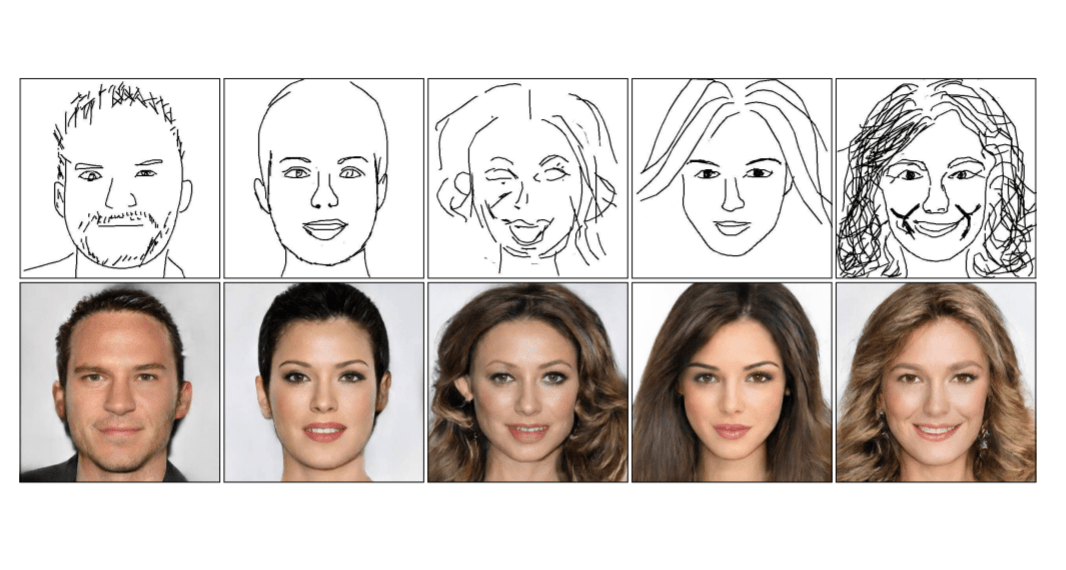
Researchers have found a way to turn simple line drawings into photo-realistic facial images. Developed by a team at the Chinese Academy of Sciences in Beijing, DeepFaceDrawing uses artificial intelligence to help “users with little training in drawing to produce high-quality images from rough or even incomplete freehand sketches.”

This isn’t the first time we’ve seen tech like this (remember the horrifying results of Pix2Pix’s autofill tool?), but it is certainly the most advanced to date, and it doesn’t require the same level of detail in source sketches as previous iterations have. It works largely through probability — instead of requiring detailed eyelid or lip shapes, for example, the software refers to a database of faces and facial components, and considers how each facial element works with each other. Eyes, nose, mouth, face shape and hair type are all considered separately, and then assembled into a single image.

As the paper explains, “Recent deep image-to-image translation techniques allow fast generation of face images from freehand sketches. However, existing solutions tend to overfit to sketches, thus requiring professional sketches or even edge maps as input. To address this issue, our key idea is to implicitly model the shape space of plausible face images and synthesize a face image in this space to approximate an input sketch. Our method essentially uses input sketches as soft constraints and is thus able to produce high-quality face images even from rough and/or incomplete sketches.”

It’s not clear how the software will handle race. Of the 17,000 sketches and their corresponding photos created so far, the majority have been Caucasian and South American faces. This could be a result of the source data (bias is an ongoing problem in the world of AI), or down to the complexity of face shapes — the researchers don’t provide any further details.

In any case, the technology is due to go on show at this year’s (virtual) SIGGRAPH conference in July. According to the project’s website, code for the software is “coming soon,” which suggests we could see its application in the wild in the coming months — not only as a fun app to play around with, but also potentially in law enforcement, helping to rapidly generate images of suspects.

Source: ‘DeepFaceDrawing’ AI can turn simple sketches into detailed photo portraits | Engadget

Researchers Have Created a Tool That Can Perfectly Depixelate Faces

The typical approach to increasing the resolution of an image is to start with the low-res version and use intelligent algorithms to predict and add additional details and pixels in order to artificially generate a high-res version. But because a low-res version of an image can lack significant details, fine features are often lost in the process, resulting in, particularly with faces, an overly soft and smoothed out appearance in the results lacking fine details. The approach a team of researchers from Duke University has developed, called Pulse (Photo Upsampling via Latent Space Exploration), tackles the problem in an entirely different way by taking advantage of the startling progress made with machine learning in recent years.

The Pulse research team from Duke University demonstrating the results (the lower row of headshots) of Pulse processing a low-res image (the middle row of headshots) compared to the original (the top row of headshots) high-res photos.
Photo: Duke University

Pulse starts with a low-res image, but it doesn’t work with or process it directly. It instead uses it as a target reference for an AI-based face generator that relies on generative adversarial networks to randomly create realistic headshots. We’ve seen these tools used before in videos where thousands of non-existent but lifelike headshots are generated, but in this case, after the faces are created, they’re downsized to the resolution of the original low-res reference and compared it against it, looking for a match. It seems like an entirely random process that would take decades to find a high-res face that matches the original sample when it’s shrunk, but the process is able to quickly find a close comparison and then gradually tweak and adjust it until it produces a down-sampled result that matches the original low-res sample.

Source: Researchers Have Created a Tool That Can Perfectly Depixelate Faces

Trillions of Words Analyzed, OpenAI Sets Loose AI Language Colossus – The API

Over the past few months, OpenAI has vacuumed an incredible amount of data into its artificial intelligence language systems. It sucked up Wikipedia, a huge swath of the rest of the internet and tons of books. This mass of text – trillions of words – was then analyzed and manipulated by a supercomputer to create what the research group bills as a major AI breakthrough and the heart of its first commercial product, which came out on Thursday.

The product name — OpenAI calls it “the API” — might not be magical, but the things it can accomplish do seem to border on wizardry at times. The software can perform a broad set of language tasks, including translating between languages, writing news stories and poems and answering everyday questions. Ask it, for example, if you should keep reading a story, and you might be told, “Definitely. The twists and turns keep coming.”

OpenAI wants to build the most flexible, general purpose AI language system of all time. Typically, companies and researchers will tune their AI systems to handle one, limited task. The API, by contrast, can crank away at a broad set of jobs and, in many cases, at levels comparable with specialized systems. While the product is in a limited test phase right now, it will be released broadly as something that other companies can use at the heart of their own offerings such as customer support chat systems, education products or games, OpenAI Chief Executive Officer Sam Altman said.

[…]

Software developers can begin training the AI system just by showing it a few examples of what they want the code to do. If you ask it a number of questions in a row, for example, the system starts to sense it’s in question-and-answer mode and tweaks its responses accordingly. There are also tools that let you alter how literal or creative you want the AI to be.

But even a layperson – i.e. this reporter – can use the product. You can simply type text into a box, hit a button and get responses. Drop a couple paragraphs of a news story into the API, and it will try to complete the piece with results that vary from I-kinda-fear-for-my-job good to this-computer-might-be-on-drugs bad.

Source: Trillions of Words Analyzed, OpenAI Sets Loose AI Language Colossus – Bloomberg

deepart.io turns your picture into versions of existing art pictures

Artificial intelligence turning your photos into art

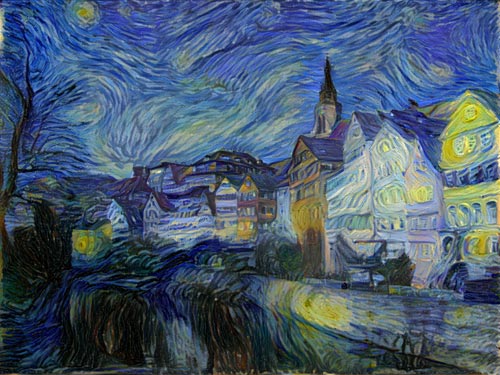
It uses the stylistic elements of one image to draw the content of another. Get your own artwork in just three steps.

  1. Upload photo

    The first picture defines the scene you would like to have painted.

  2. Choose style

    Choose among predefined styles or upload your own style image.

  3. Submit

    Our servers paint the image for you. You get an email when it’s done.

Source: deepart.io – become a digital artist

Secure the software development lifecycle with machine learning

At Microsoft, 47,000 developers generate nearly 30 thousand bugs a month. These items get stored across over 100 AzureDevOps and GitHub repositories. To better label and prioritize bugs at that scale, we couldn’t just apply more people to the problem. However, large volumes of semi-curated data are perfect for machine learning. Since 2001 Microsoft has collected 13 million work items and bugs. We used that data to develop a process and machine learning model that correctly distinguishes between security and non-security bugs 99 percent of the time and accurately identifies the critical, high priority security bugs, 97 percent of the time. This is an overview of how we did it.

Source: Secure the software development lifecycle with machine learning – Microsoft Security

Live analytics without vendor lock-in? It’s more likely than you think, says Redis Labs

In February, Oracle slung out a data science platform that integrated real-time analytics with its databases. That’s all well and good if developers are OK with the stack having a distinctly Big Red hue, but maybe they want choice.

This week, Redis Labs came up with something for users looking for help with the performance of real-time analytics – of the kind used for fraud detection or stopping IoT-monitored engineering going kaput – without necessarily locking them into a single database, cloud platform or application vendor.

Redis Labs, which backs the open-source in-memory Redis database, has built what it calls an “AI serving platform” in collaboration with AI specialist Tensorwerk.

RedisAI includes deploying the model, running the inferencing and performance monitoring within the database bringing analytics closer to the data, and improving performance, according to Redis Labs.

Bryan Betts, principal analyst with Freeform Dynamics, told us the product was aimed at a class of AI apps where you need to constantly monitor and retrain the AI engine as it works.

“Normally you have both a compute server and a database at the back end, with training data moving to and fro between them,” he said. “What Redis and Tensorwerk have done is to build the AI computation ability that you need to do the retraining right into the database. This should cut out a stack of latency – at least for those applications that fit its profile, which won’t be all of them.”

Betts said other databases might do the same, but developers would have to commit to specific AI technology. To accept that lock-in, they would need to be convinced the performance advantages outweigh the loss of the flexibility to choose the “best” AI engine and database separately.

IDC senior research analyst Jack Vernon told us the Redis approach was similar to that of Oracle’s data science platform, where the models sit and run in the database.

“On Oracle’s side, though, that seems to be tied to their cloud,” he said. “That could be the real differentiating thing here: it seems like you can run Redis however you like. You’re not going to be tied to a particular cloud infrastructure provider, unlike a lot of the other AI data science platforms out there.”

SAP, too, offers real-time analytics on its in-memory HANA database, but users can expect to be wedded to its technologies, which include the Leonardo analytics platform.

Redis Labs said the AI serving platform would give developers the freedom to choose their own AI back end, including PyTorch and TensorFlow. It works in combination with RedisGears, a serverless programmable engine that supports transaction, batch, and event-driven operations as a single data service and integrates with application databases such as Oracle, MySQL, SQLServer, Snowflake or Cassandra.

Yiftach Shoolman, founder and CTO at Redis Labs, said that while researchers worked on improving the chipset to boost AI performance, this was not necessarily the source of the bottleneck.

“We found that in many cases, it takes longer to collect the data and process it before you feed it to your AI engine than the inferences itself takes. Even if you improve your inferencing engine by an order of magnitude, because there is a new chipset in the market, it doesn’t really affect the end-to-end inferencing time.”

Analyst firm Gartner sees increasing interest in AI ops environments over the next four years to improve the production phase of the process. In the paper “Predicts 2020: Artificial Intelligence Core Technologies”, it says: “Getting AI into production requires IT leaders to complement DataOps and ModelOps with infrastructures that enable end-users to embed trained models into streaming-data infrastructures to deliver continuous near-real-time predictions.”

Vendors across the board are in an arms race to help users “industrialise” AI and machine learning – that is to take it from a predictive model that tells you something really “cool” to something that is reliable, quick, cheap and easy to deploy. Google, AWS and Azure are all in the race along with smaller vendors such as H2O.ai and established behemoths like IBM.

While big banks like Citi are already some way down the road, vendors are gearing up to support the rest of the pack. Users should question who they want to be wedded to, and what the alternatives are

Source: Live analytics without vendor lock-in? It’s more likely than you think, says Redis Labs • The Register

Create Deepfakes in 5 Minutes with First Order Model Method

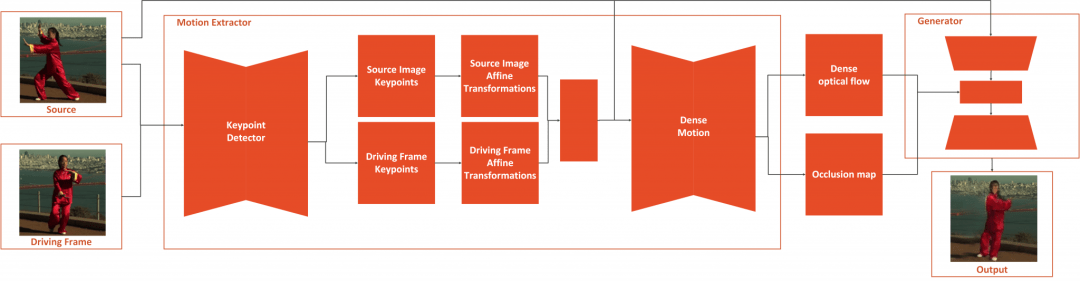
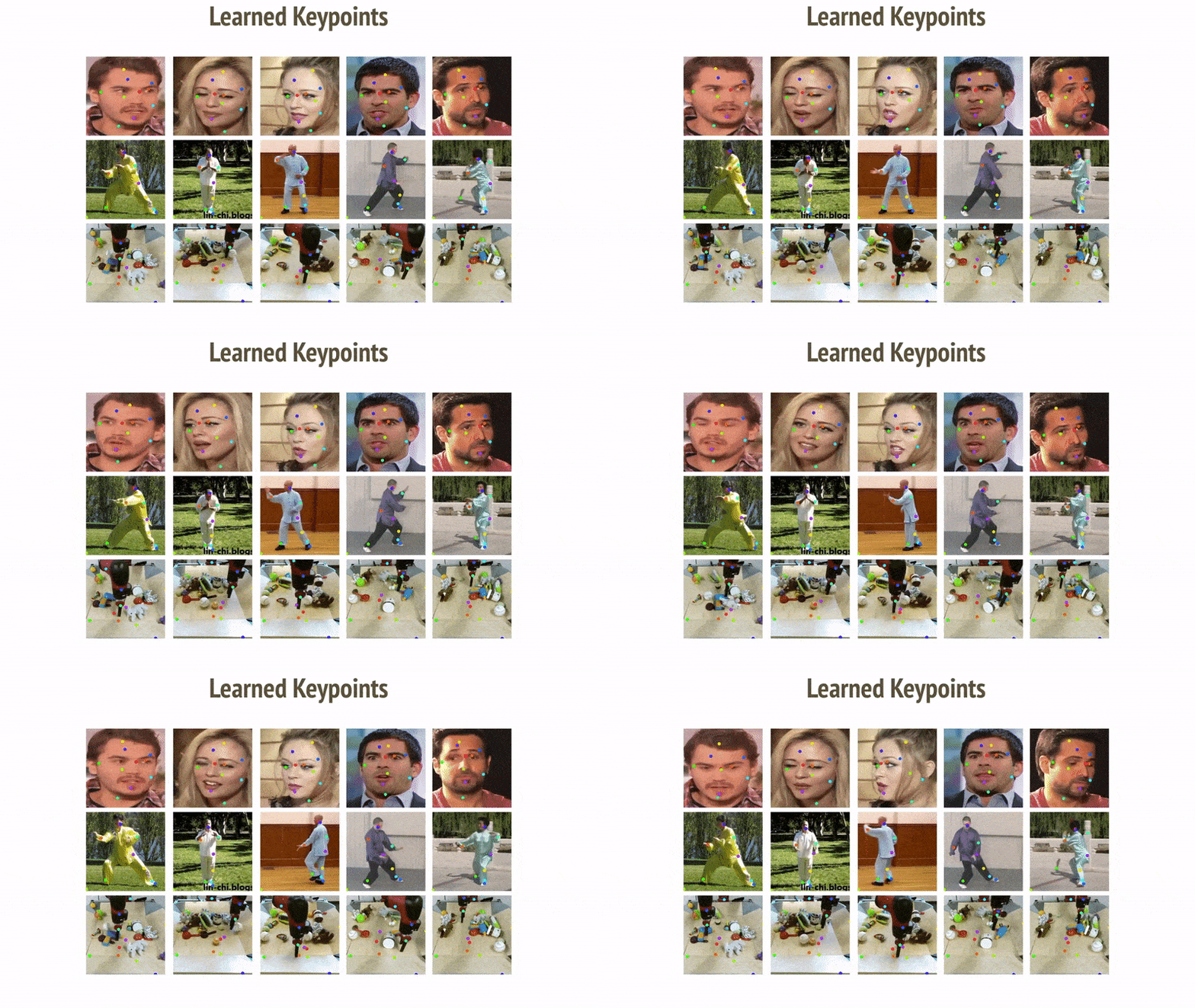
et’s explore a bit how this method works. The whole process is separated into two parts: Motion Extraction and Generation. As an input the source image and driving video are used. Motion extractor utilizes autoencoder to detect keypoints and extracts first-order motion representation that consists of sparse keypoints and local affine transformations. These, along with the driving video are used to generate dense optical flow and occlusion map with the dense motion network. Then the outputs of dense motion network and the source image are used by the generator to render the target image.

First Order Model Approach

This work outperforms state of the art on all the benchmarks. Apart from that it has features that other models just don’t have. The really cool thing is that it works on different categories of images, meaning you can apply it to face, body, cartoon, etc. This opens up a lot of possibilities. Another revolutionary thing with this approach is that now you can create good quality Deepfakes with a single image of the target object, just like we use YOLO for object detection.

Keypoints Detection

If you want to find out more about this method, check out the paper and the code. Also, you can watch the following video:

Building your own Deepfake

As mention, we can use already trained models and use our source image and driving video to generate deepfakes. You can do so by following this Collab notebook.

In essence, what you need to do is clone the repository and mount your Google Drive. Once that is done, you need to upload your image and driving video to drive. Make sure that image and video size contains only face, for the best results. Use ffmpeg to crop the video if you need to. Then all you need is to run this piece of code:

source_image = imageio.imread('/content/gdrive/My Drive/first-order-motion-model/source_image.png')
driving_video = imageio.mimread('driving_video.mp4', memtest=False)


#Resize image and video to 256x256

source_image = resize(source_image, (256, 256))[..., :3]
driving_video = [resize(frame, (256, 256))[..., :3] for frame in driving_video]

predictions = make_animation(source_image, driving_video, generator, kp_detector, relative=True,
                             adapt_movement_scale=True)

HTML(display(source_image, driving_video, predictions).to_html5_video())

Here is my experiment with image of Nikola Tesla and a video of myself:

Conclusion

We are living in a weird age in a weird world. It is easier to create fake videos/news than ever and distribute them. It is getting harder and harder to understand what is truth and what is not. It seems that nowadays we can not trust our own senses anymore. Even though fake video detectors are also created, it is just a matter of time before the information gap is too small and even the best fake detectors can not detect if the video is true or not. So, in the end, one piece of advice – be skeptical. Take every information that you get with a bit of suspicion because things might not be quite as it seems.

Thank you for reading!

Source: Create Deepfakes in 5 Minutes with First Order Model Method

Facebook releases Blender AI Chatbot sources

  • Facebook AI has built and open-sourced Blender, the largest-ever open-domain chatbot. It outperforms others in terms of engagement and also feels more human, according to human evaluators.

  • The culmination of years of research in conversational AI, this is the first chatbot to blend a diverse set of conversational skills — including empathy, knowledge, and personality — together in one system.

  • We achieved this milestone through a new chatbot recipe that includes improved decoding techniques, novel blending of skills, and a model with 9.4 billion parameters, which is 3.6x more than the largest existing system.

  • Today we’re releasing the complete model, code, and evaluation set-up, so that other AI researchers will be able to reproduce this work and continue to advance conversational AI research.

[…]

As the culmination of years of our research, we’re announcing that we’ve built and open-sourced Blender, the largest-ever open-domain chatbot. It outperforms others in terms of engagement and also feels more human, according to human evaluators. This is the first time a chatbot has learned to blend several conversational skills — including the ability to assume a persona, discuss nearly any topic, and show empathy — in natural, 14-turn conversation flows. Today we’re sharing new details of the key ingredients that we used to create our new chatbot.

Some of the best current systems have made progress by training high-capacity neural models with millions or billions of parameters using huge text corpora sourced from the web. Our new recipe incorporates not just large-scale neural models, with up to 9.4 billion parameters — or 3.6x more than the largest existing system — but also equally important techniques for blending skills and detailed generation.

[…]

We’re currently exploring ways to further improve the conversational quality of our models in longer conversations with new architectures and different loss functions. We’re also focused on building stronger classifiers to filter out harmful language in dialogues. And we’ve seen preliminary success in studies to help mitigate gender bias in chatbots.

True progress in the field depends on reproducibility — the opportunity to build upon the best technology possible. We believe that releasing models is essential to enable full, reliable insights into their capabilities. That’s why we’ve made our state of the art open-domain chatbot publicly available through our dialogue research platform ParlAI. By open-sourcing code for fine-tuning and conducting automatic and human evaluations, we hope that the AI research community can build on this work and collectively push conversational AI forward.


Read the paper here.


Get the code here.

Source: A state-of-the-art open source chatbot

Google’s medical AI was super accurate in a lab. Real life was a different story, so they need to tweak

The covid-19 pandemic is stretching hospital resources to the breaking point in many countries in the world. It is no surprise that many people hope  AI could speed up patient screening and ease the strain on clinical staff. But a study from Google Health—the first to look at the impact of a deep-learning tool in real clinical settings—reveals that even the most accurate AIs can actually make things worse if not tailored to the clinical environments in which they will work.

Existing rules for deploying AI in clinical settings, such as the standards for FDA clearance in the US or a CE mark in Europe, focus primarily on accuracy. There are no explicit requirements that an AI must improve the outcome for patients, largely because such trials have not yet run. But that needs to change, says Emma Beede, a UX researcher at Google Health: “We have to understand how AI tools are going to work for people in context—especially in health care—before they’re widely deployed.”

[…]

Google’s first opportunity to test the tool in a real setting came from Thailand. The country’s ministry of health has set an annual goal to screen 60% of people with diabetes for diabetic retinopathy, which can cause blindness if not caught early. But with around 4.5 million patients to only 200 retinal specialists—roughly double the ratio in the US—clinics are struggling to meet the target. Google has CE mark clearance, which covers Thailand, but it is still waiting for FDA approval. So to see if AI could help, Beede and her colleagues outfitted 11 clinics across the country with a deep-learning system trained to spot signs of eye disease in patients with diabetes.

In the system Thailand had been using, nurses take photos of patients’ eyes during check-ups and send them off to be looked at by a specialist elsewhere­—a process that can take up to 10 weeks. The AI developed by Google Health can identify signs of diabetic retinopathy from an eye scan with more than 90% accuracy—which the team calls “human specialist level”—and, in principle, give a result in less than 10 minutes. The system analyzes images for telltale indicators of the condition, such as blocked or leaking blood vessels.

Sounds impressive. But an accuracy assessment from a lab goes only so far. It says nothing of how the AI will perform in the chaos of a real-world environment, and this is what the Google Health team wanted to find out. Over several months they observed nurses conducting eye scans and interviewed them about their experiences using the new system. The feedback wasn’t entirely positive.

When it worked well, the AI did speed things up. But it sometimes failed to give a result at all. Like most image recognition systems, the deep-learning model had been trained on high-quality scans; to ensure accuracy, it was designed to reject images that fell below a certain threshold of quality. With nurses scanning dozens of patients an hour and often taking the photos in poor lighting conditions, more than a fifth of the images were rejected.

Patients whose images were kicked out of the system were told they would have to visit a specialist at another clinic on another day. If they found it hard to take time off work or did not have a car, this was obviously inconvenient. Nurses felt frustrated, especially when they believed the rejected scans showed no signs of disease and the follow-up appointments were unnecessary. They sometimes wasted time trying to retake or edit an image that the AI had rejected.

Because the system had to upload images to the cloud for processing, poor internet connections in several clinics also caused delays. “Patients like the instant results, but the internet is slow and patients then complain,” said one nurse. “They’ve been waiting here since 6 a.m., and for the first two hours we could only screen 10 patients.”

The Google Health team is now working with local medical staff to design new workflows. For example, nurses could be trained to use their own judgment in borderline cases. The model itself could also be tweaked to handle imperfect images better.

[…]

Source: Google’s medical AI was super accurate in a lab. Real life was a different story. | MIT Technology Review

Of course the anti ML people are using this as some sort of AI will never work kind of way, but as far as I can see these kinds of tests are necessary and seemed to have been performed with oversight, meaning there was no real risk to patients involved. Lessons were learned and will be implemented, as with all new technologies. And going public with the lessons is incredibly useful for everyone in the field.

Google Translate launches Transcribe for Android in 8 languages

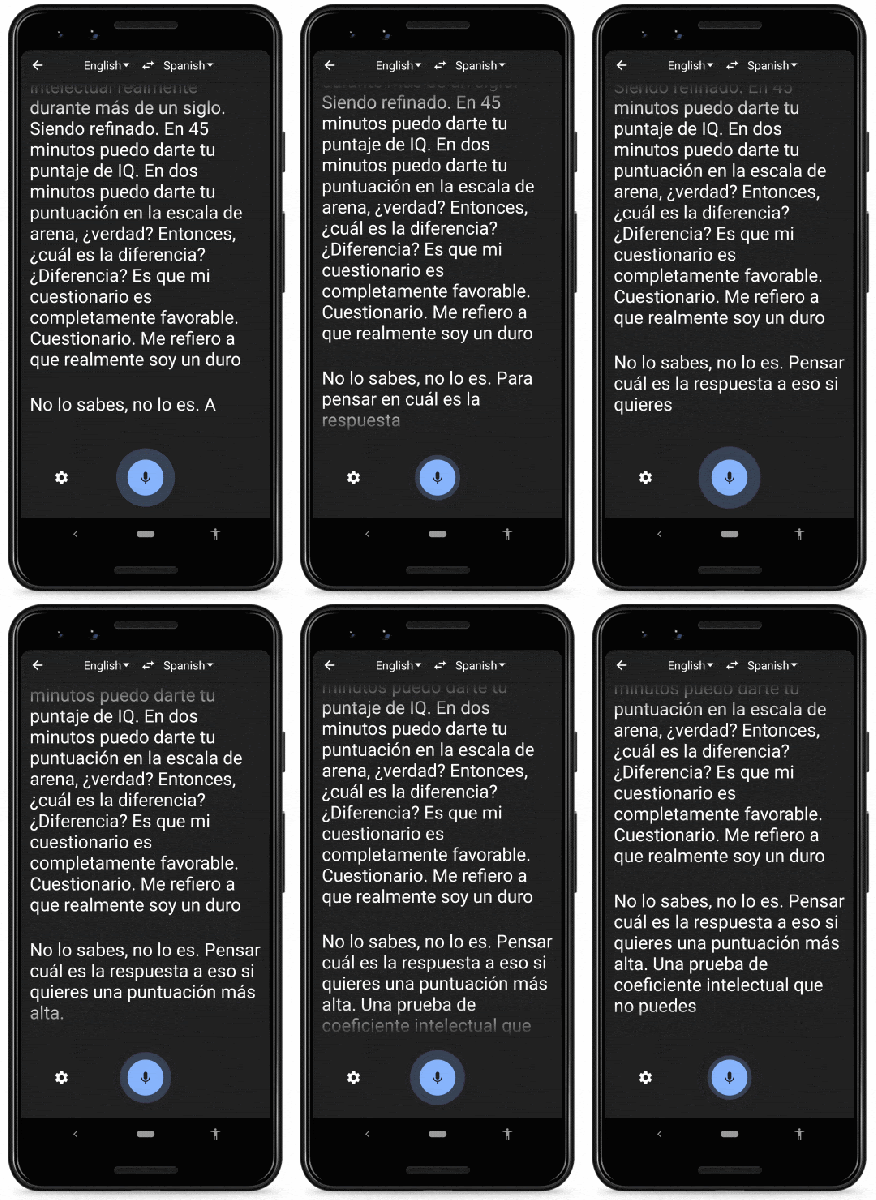
Google Translate today launched Transcribe for Android, a feature that delivers a continual, real-time translation of a conversation. Transcribe will begin by rolling out support for eight languages in the coming days: English, French, German, Hindi, Portuguese, Russian, Spanish and Thai. With Transcribe, Translate is now capable of translating classroom or conference lectures with no time limits, whereas before speech-to-text AI in Translate lasted no longer than a word, phrase, or sentence. Google plans to bring Transcribe to iOS devices at an unspecified date in the future.

Source: Google Translate launches Transcribe for Android in 8 languages | VentureBeat

TensorFlow Quantum

TensorFlow Quantum (TFQ) is a quantum machine learning library for rapid prototyping of hybrid quantum-classical ML models. Research in quantum algorithms and applications can leverage Google’s quantum computing frameworks, all from within TensorFlow.

TensorFlow Quantum focuses on quantum data and building hybrid quantum-classical models. It integrates quantum computing algorithms and logic designed in Cirq, and provides quantum computing primitives compatible with existing TensorFlow APIs, along with high-performance quantum circuit simulators. Read more in the TensorFlow Quantum white paper.

Source: TensorFlow Quantum

Utah has given all its camera feeds to an AI, turning it Into a Surveillance Panopticon

The state of Utah has given an artificial intelligence company real-time access to state traffic cameras, CCTV and “public safety” cameras, 911 emergency systems, location data for state-owned vehicles, and other sensitive data.

The company, called Banjo, says that it’s combining this data with information collected from social media, satellites, and other apps, and claims its algorithms “detect anomalies” in the real world.

The lofty goal of Banjo’s system is to alert law enforcement of crimes as they happen. It claims it does this while somehow stripping all personal data from the system, allowing it to help cops without putting anyone’s privacy at risk. As with other algorithmic crime systems, there is little public oversight or information about how, exactly, the system determines what is worth alerting cops to.

Source: This Small Company Is Turning Utah Into a Surveillance Panopticon – VICE

Browser Tool Erases People From Live Webcam Feeds in Real Time

Jason Mayes apparently likes to do things the hard way: He’s developed an AI-powered tool for browsers that can erase people from live webcam feeds in real-time but leave everything else in the shot.

Mayes is a Google web engineer who developed his Disappearing-People tool using Javascript and TensorFlow, which is Google’s free, open source software library that allows the terrifying potential of artificial intelligence and deep learning to be applied to less terrifying applications. In this case, the neural network works to determine what the static background imagery of a video is in order to develop a clean plate—a version without any humans moving around in the frame—without necessarily requiring the feed to be free of people to start with.

The neural network used in this instance is trained to recognize people, and using that knowledge it can not only generate a clean image of a webcam feed’s background, but it can then actively erase people as they walk into frame and move around, in real-time, while allowing live footage of everything else happening in the background to remain.

Mayes has created test versions of the tool that you can access and try yourself in a browser through his personal GitHub repository. The results aren’t 100 percent perfect just yet (you can still see quite a few artifacts popping up here and there in the sample video he shared where he walks into frame), but as the neural network powering this tool continues to improve, so will the results.

Source: Browser Tool Erases People From Live Webcam Feeds in Real Time