2TB USB the size of your Finger Nail | Netbooknews – Netbooks, Netbook Reviews, Smartbooks and more.

The inkling uses a pen and a module you put on the top of any notebook in order to allow you to save what you draw on any paper electronically.
Stanford scientists used a grid-structured electrode, which is fabricated by a microfluidics-assisted method, such that the feature dimension in the electrode is below the resolution limit of human eyes, and, thus, the electrode appears transparent. By aligning multiple electrodes together, the amount of energy stored increases readily without sacrificing the transparency. In addition, the battery is flexible, further broadening their potential applications.
There’s a fundamental flaw with fan-and-heatsink cooling systems: no matter how hard the fan blows, a boundary layer of motionless, highly-insulating air remains on the heatsink. You can increase the size of the heatsink and you can blow more air, but ultimately the boundary layer prevents the system from being efficient; it’s simply a physical limitation of fan-and-heatsink cooling systems in specific, and every kind of air-cooled heat exchanger in general, including air conditioning and refrigeration units.
But what if you did away with the fan? What if the heatsink itself rotated? Well, believe it or not, rotating the heat exchanger obliterates the boundary layer, removes the need for a fan, and it’s so efficient that it can operate at low and very quiet speeds.

via The fanless spinning heatsink: more efficient and immune to dust | ExtremeTech.
Driving distractions, primarily by cellphones and other electronic devices, are associated with up to 25 percent of U.S. car crashes, according to a report released on Thursday.
The study by the Governors Highway Safety Association (GHSA), a nonprofit group that works to improve traffic safety, assessed research from more than 350 scientific papers published since 2000.
It showed that drivers are distracted up to half the time and that crashes caused by distractions range from minor damage to fatal injury. Cellphone use raises the risk of crashing, but texting is likely to increase crash risk more than cellphone use.
via Gadgets tied to 25 percent of car crashes: report – Technology & science – Wireless – msnbc.com.
Pretty cool – the world is your PCB board!
Silver pen allows electrical circuits to be handwritten on paper and other surfaces.
There’s quite a few ways to turn your pc into a motion detector, the most common seems to be using a webcam and flash.
This works well, but here are a few ways to do it differently:
This is the DIY way
Turn Your PC Into a Motion Sensing Security Device with .NET.
NB the ultrasonic sensor in above article can now be found at Parallax inc here
This guy hooked up his PIR motion sensor to a logitech mouse to simulate the mousepress and turn his monitor on.
The Go!Motion is a complete expermenters tool, so not so good for the kiosk market but interesting nonetheless. It costs $135,-
Circuitgizmos.com has a USB PIR motion detector for $44,99. It looks like it’s pretty basic and still quite DIY.
The KSL Embedded Glob-x USB PIR sensor goes for $55,- and looks most like a plug and play product. It comes with some lovely software to set the sensitivity and what actions to perform when triggered.
Which is a shitload cheaper than the JVC KD-AVx77 (EUR. 600,-) or KW-AVX840 (EUR 500,-). It’s a two DIN unit and there’s not so much functionality as the JVC’s have – it only has 4 apps which are limited but Pioneer say they will be adding more.
Pioneer’s AppRadio delivers iPhone integration, automotive and audio bliss for $400 — Engadget.
Features:
|
|
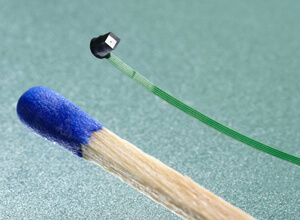
The German Fraunhofer Institute for Reliability and Microintegration recently reported the development of a camera with a lens attached that is 1 x 1 x 1.5 millimeters in size, which is the size of a grain of salt. At about a cubic millimeter in size, this camera is right at the size limit that the human eye can see unaided. The camera not only produces decent images but it is also very cheap to manufacture…so cheap in fact that it is considered disposable.
Resolution: 250 x 250 @ 40Hz
New Disposable, Medical Camera Is the Size of a Grain of Salt | Singularity Hub.
This features a pull out system for your old 35 mm camera, turning it into a digital one. It has a USB connection for copying the pictures and recharging. Unfortunately, it looks like it’s not real, but an April Fools joke.
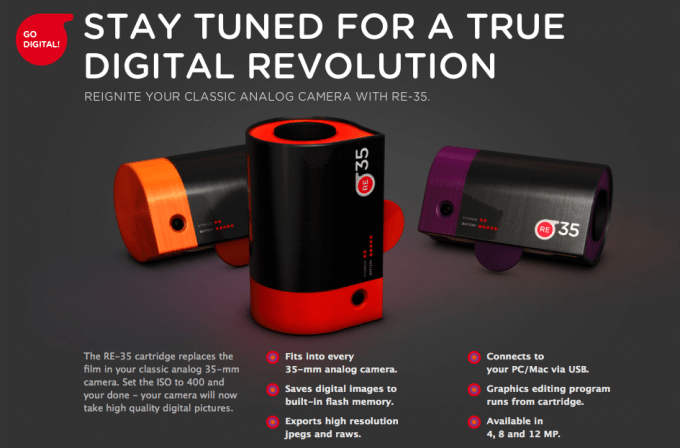
Everyone who sees it wishes it was a real product though, it’s making huge noise on tha intarwebs.
RE-35 | Digital cartridges for analog 35-mm cameras.
The evoMouse is the evolution of the computer mouse.
With the evoMouse, your finger is your pointer and there is no more pushing around a physical mouse.
The evoMouse works on nearly any flat surface and requires very little space. It tracks effortlessly to your comfortable and natural movements.
With the evoMouse, you can perform common mouse operations using only your fingers. You can control the cursor, click and select, double-click, right-click and drag with basic hand gestures.
The evoMouse also features multi-touch functionality including scroll, rotate, zoom, forward and back. The evoMouse can even be used for handwriting recognition with your finger or a pen.
The evoMouse is easy and convenient to set up and use with almost any desktop or laptop computer. It connects via Bluetooth or a standard USB port.Because it allows natural movements and doesn’t require pushing around a physical object, the evoMouse may help reduce repetitive stress injuries like Carpal Tunnel Syndrome.
via ++CELLUON ++.
A Japanese inventor has found a way to convert plastic grocery bags, bottles and caps into usable petroleum.
Plastic bags are, of course, made from petroleum to begin with, but it is not the same kind of petroleum that is used in fuel. In order to turn home waste into home power the machine heats up the waste plastic and traps the vapors created in a system of pipes and water chambers. Finally, the machine condenses the vapors into crude oil, that can be used for heating on the home level
via New invention can turn your plastic bags into fuel at home.
inPulse is the perfect hacker accessory – a fully programmable Bluetooth SmartWatch.
inPulse is totally customizable. Our SDK can get you saying ‘Hello, Watch!’ in 5 minutes! Dive deeper and create your own app running right on top of our embedded OS. Code in C and get control over the OLED display, Bluetooth connection, vibrating motor, button, timers, interrupts and more.

via Get inPulse and Hack Your Watch | Hack inPulse: Features.
My current jawbone has a worse speaker than the Jabra and the earpiece holder doesn’t work so well for me. Now they have a new system to hold it in your ear which hopefully works better, but they’ve addressed all the other niggles I had AND added an accellerometer! oh, and you can see the battery level on your iphone, next to the battery indicator of the iphone.
The price: $129,- for all this bluetooth headset goodness.
Shake the Baby! Jawbone’s Newest Headset Likes it Physical.
Waterproof, windproof matches burn in heavy rain and even while wet! Match will not go out until chemical has burned out, then stick can be doused in water to completely extinguish the fire Match sticks are 2 3/4 inches long for added safety to keep from burning fingertips
via REI Storm Proof Matches at REI.com.
FPV = first person viewer. These guys put on a headset and fly their UAV’s or drive their cars whilst looking from the vantage of the vehicle. This page tells you about the planes and aircraft and other equipment it recommends.
13 functions, you can program it by pressing your old remote whilst holding it to your wand.

ThinkGeek :: Magic Wand – Programmable TV Remote.
Kiwi Wifi is a plug and play wireless device measuring only 2.75 x 1.25 x 0.6 inches. Kiwi Wifi comes attached with a 6 ft OBDII cable for easy installation. It also comes included with a power switch built-in to prevent the need for having to constantly disconnect your unit from the OBDII port. It is compatible with 1996 and later vehicles. Connecting to your iPhone / iPod touch is made by 802.11a/b/g connection in adHoc mode. This unit is upgradeable to Kiwi Wifi + iMFD.

via PLX Kiwi Wifi – Connect your iPhone / iPod Touch to your car’s OBD2 OBDII Port..
This plugs into the ODBC port of your car and feeds information to your mobile / desktop device through the cloud as well as sending information (such as GPS location) and making automated phone calls after events, such as your airbags going off.

Hopefully they’ll make it an open architecture so we can see cool car tuner apps for it!
Mavizon Technologies – About Autobot.
These things are ruggedised and for the price they aren’t expensive at all…
GoPro Official Store: Wearable Digital Cameras for Sports.