[Kagen Sound] is a woodworker and artist who gives a great behind-the-scenes look at his amazingly high-quality puzzle boxes (video). Not only do his varied puzzle box designs show his math background, but they are all made entirely of wood. There are no nails or fasteners; just intricately-fitted wood and some glue.
There’s a lot of variety in his designs, and while it’s all fantastic from beginning to end, two things stood out to us as being of particular interest. One is the “Plus Box” which makes a clicking sound when the pieces are moved (at 2:47) thanks to a clever wooden spring. [Kagen] shows an example of the concept, where a flat wood piece with slots cut from the sides acts as a spring and clicks into notches when moved, providing audible and tactile feedback without anything other than wood.
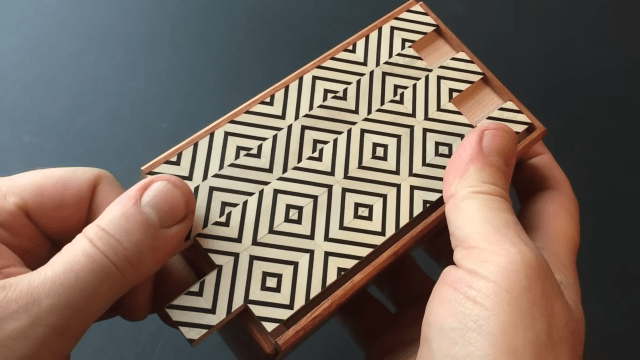
The other is a patterned puzzle box (at 7:10) whose geometric designs change as the user moves the pieces. A reminder that [Kagen]’s devices are made entirely of wood and glue, so the design comes from two different types of wood assembled and cut at an angle to create the patterns seen. [Kagen] shaves thin layers of veneer from this block to attach to the puzzle pieces as needed to create the patterns without resorting to ink, paint, or decals.
[Kagen] has a math degree but is entirely self-taught as a woodworker, so don’t let lack of formal training stop you from experimenting. You can watch him give a tour of his work in the video, embedded below.
Samsung just announced that its self-repair program will now include certain home entertainment devices. The company has developed a range of step-by-step repair guides for various products in the category, in addition to providing genuine replacement parts and repair tools.
This program covers Samsung 2023 TVs, along with their remotes, and monitors released throughout the past year or so. Additionally, the self-repair program now includes the second-generation Freestyle projector and select soundbars. You can pick up replacement parts directly from the company.
Of course, the program doesn’t cover every repair issue. For TVs and monitors, the program only handles issues related to the picture, power, WiFi connection, sound and remote control. For soundbars, the program covers problems related to HDMI and optical connections, power, sound and wireless communication. According to Samsung, most of these issues can be fixed with common tools like a Phillips-head screwdriver.
The company’s been on something of a self-repair spree in recent months. Back in December, Samsung opened up the program to foldable devices, like the Galaxy Z Flip 5 and Z Fold 5. In the first part of 2023, the company added S22 and Galaxy Book devices to the program, joining pre-existing Galaxy products.
To that end, Samsung just announced a broader assortment of self-repair parts for devices already included in the program. This includes speakers, SIM trays, side keys, volume keys, display assemblies, back glass and charging ports for phones and tablets. Galaxy Book owners can also now conduct DIY repairs to fix the speakers and fan. Meanwhile, rival Apple doesn’t exactly have the best track record in the self-repair movement.
It’s good to see a return to being able to repair stuff. Not only does this make repairs cheaper, faster and easier but also it allows you to keep your device running for far longer. Considering the amount of damage being done to the environment by electronic device junk, is absolutely a good thing.
Swarovski has turned up at CES 2024 in Las Vegas with its first ever pair of smart binoculars that will identify the bird you’re looking at. All you have to do is point the gear at a bird and make sure the view is in focus, and then press down an action button. Within a few seconds, the system will overlay a bird’s name over your view, using data pulled from the Merlin Bird ID database. That has over 9,000 species tagged, and will even let you know the degree of certainty it has if the bird in question is in an unexpected location. And if this was the only feature these binoculars had, it’d be enough to justify the purchase, but that’s only the beginning of what these things can do.
Between the eyepieces, there’s a function wheel similar to one you would find on a camera that lets you cycle between various features. That includes a Wildlife ID version which hooks into its built-in Mammal, Dragonfly and Butterfly ID databases. Plus, there’s a camera which lets you send pictures and video to a paired smartphone, which would similarly be plenty to justify the expense. But the system is also designed to be expandable, with the focus wheel including space for any future custom databases you might need. For instance, one idea could be to build a database for stars, or airplane types for aviation fans to spot the make and model of what’s flying overhead.
Then there’s the discovery sharing feature, which enables you to share something you’ve found with whoever you’re outdoors with. All you need to do is tag whatever you’ve found, and then hand the AX Visio over to them, where a series of flashing arrows will guide them to where you were looking. Even in the busy halls of CES, one of the company’s representatives was able to pinpoint a far-off fire exit sign before handing me the binoculars and asking me to find it. All you need to do is follow the arrows straight to what you’re meant to be looking at with a system that’s as elegant as it is useful. There’s even a built-in compass that’ll let you identify which direction you’re gazing toward to help you navigate.
You might notice from the pictures that there are three lenses, with the central one holding the 13-megapixel sensor shooting HD-quality (1,920 x 1,080) pictures and video. There’s 8GB storage, which should hold up to an hour of video or 1,700 photos before needing to be cleared off. Beyond the smarts, the binoculars magnify up to 10x with 88 percent light transmission, thanks to the company’s high-end lenses. Swarovski says its glassware offers almost flat, distortion-free images with plenty of contrast and color fidelity.
Now, here’s the thing, my father-in-law is a serious ornithologist who is respected, at least among his peer group. His ability to spot the genus and species of a bird in flight is extraordinary and I’m often left bewildered at the depth of his knowledge. I don’t think I’d have the ability, patience or time to even get within a hundred miles of his capability. But, with a device like this, it might mean that I can at least vaguely keep up with him when we’re out on the trails.
The AX Visio is, however, not messing around with price, and Swarovski is charging €4,600 (around $5,000) for you to get this into your hands. While bird fans often have to be patient, this should start arriving at people’s homes at some point in February.
The MouthPad^ is a tongue-driven interface that controls your computer, smartphone, or tablet via Bluetooth. Virtually invisible to the world, but always available to you, it is positioned across the roof of your mouth to put all of the power of a conventional touchpad at the tip of your tongue
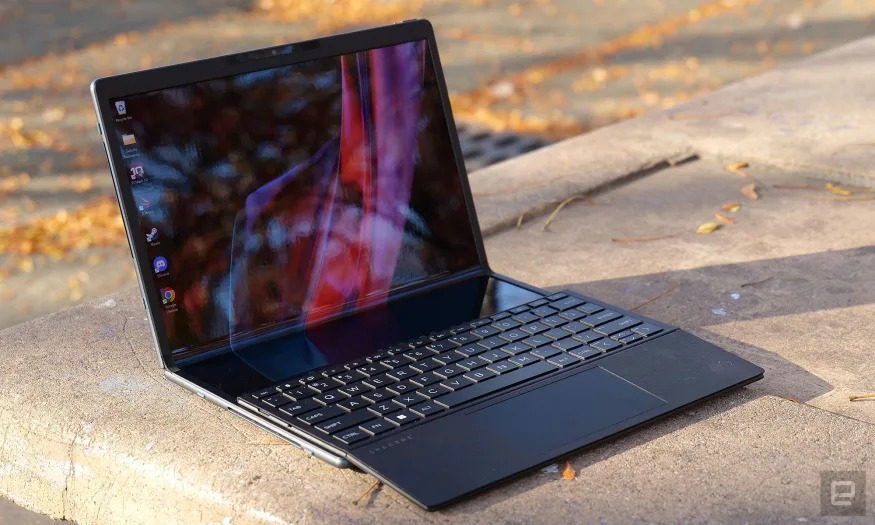
It’s rare, but now and then a company will go out on a limb and create a truly cutting-edge device, even if its books take a hit. That’s exactly what HP has done with the Spectre Fold. Despite having the same processor as last year’s ASUS Zenbook 17 OLED, HP’s take on a flexible-screen laptop is thinner, lighter and more polished than anything that’s come before it. The Spectre Fold represents a true leap when it comes to next-gen hybrid design to the point where you might even want to buy one. The issue is that at $5,000, this thing will blow up pretty much anyone’s budget.
Display
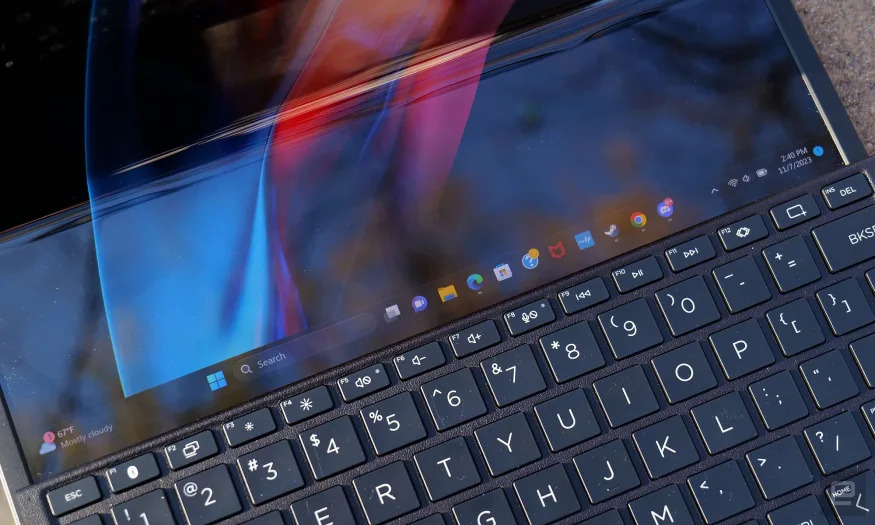
The centerpiece of the Spectre Fold is its 17-inch 2,560 x 1,920 OLED panel from LG, which features plenty of brightness (400 nits for SDR content or up to 500 nits with HDR) and an impressive color gamut (99.5 percent of DCI-P3). More importantly, it’s got thin bezels and only the faintest hint of a crease. This means in laptop mode, the Spectre Fold looks almost like any other small ultraportable, with what is effectively a 12.5-inch screen. But at a moment’s notice, you can pull its keyboard down to create what HP calls Expanded mode (which gives you the equivalent of one and a half screens) or prop the system up on its kickstand to use its full 17-inch panel. So depending on your needs, you get the perfect-sized display for your content or working space. And as a kid who grew up watching Transformers, there’s something magical about a portable all-in-one that you can pack up and easily toss in a bag. (I still haven’t decided if the Spectre Fold is more like Perceptor or closer to a bot like Reflector though.)
Design
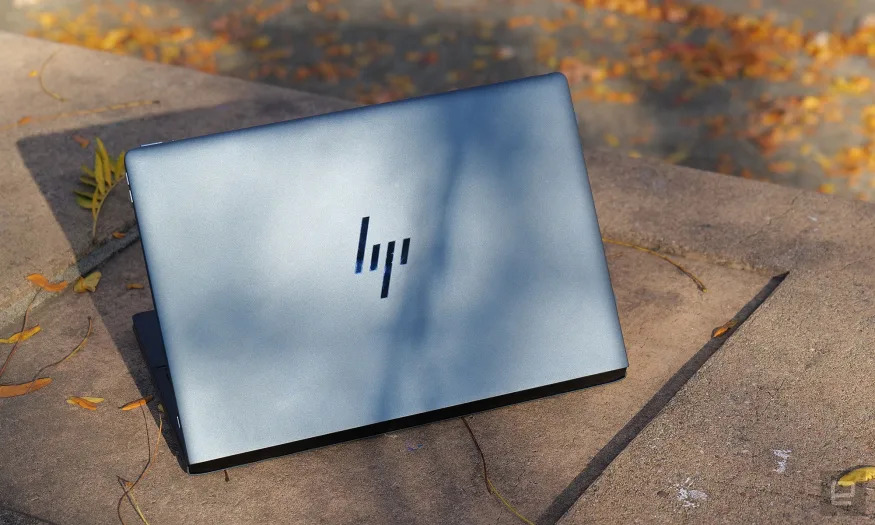
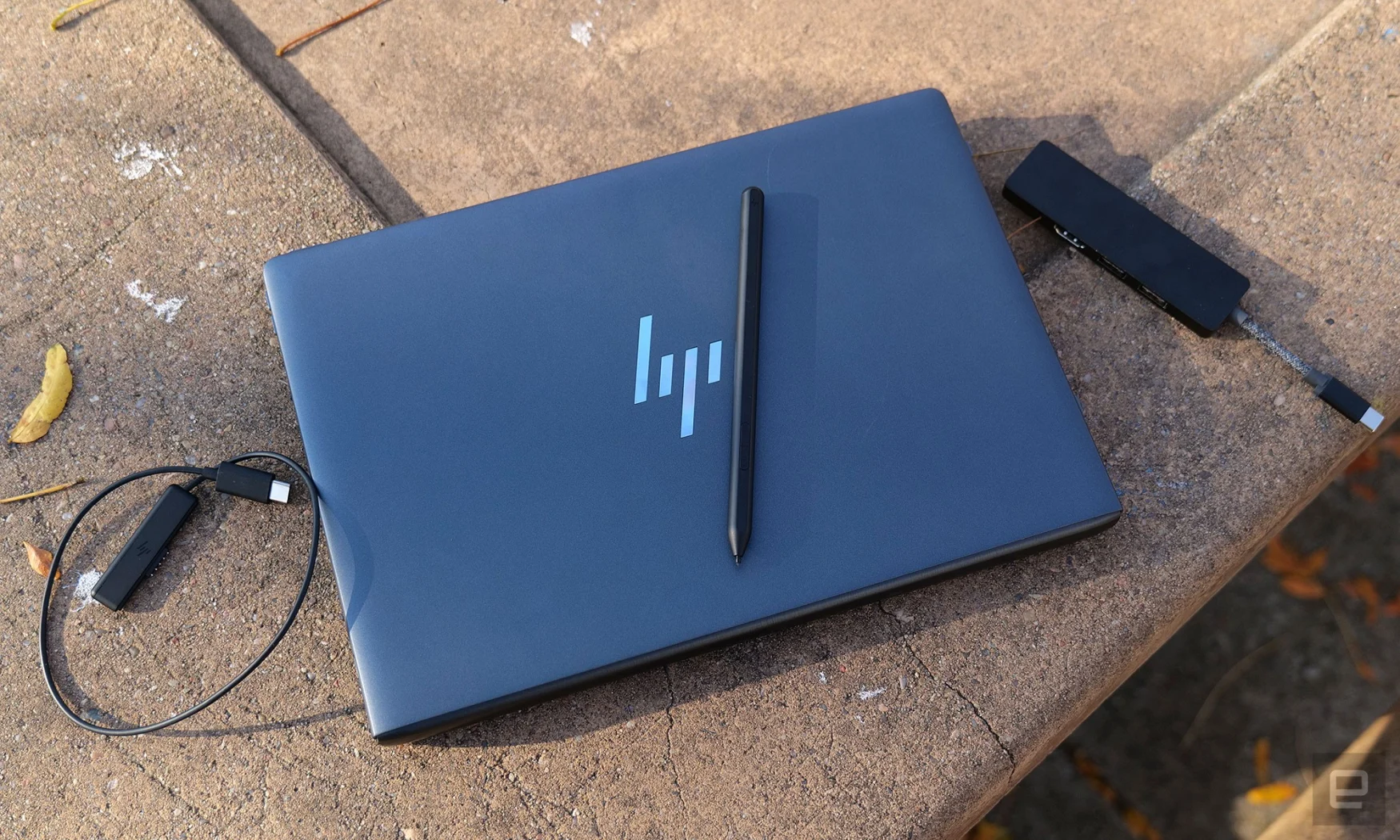
However, where HP really flexes its skills is with the Spectre Fold’s design. Unlike the Zenbook 17 Fold which had a clunky design and flaky peripherals, it feels like HP has accounted for every detail. There’s a kickstand that folds flush against the body of the system, so it disappears when not in use. And its keyboard fits neatly inside the system when closed, while hidden magnetic charging coils keep both the keyboard and HP’s included stylus topped up so they’re always ready to go. The whole kit weighs just 3.58 pounds and measures 0.84 inches thick (when closed), which is significantly thinner and lighter than ASUS’ flexible Zenbook (4.04 pounds, 1.25 inches).
Also, unlike the ASUS, there was virtually no setup involved. The keyboard automatically paired itself during the Spectre Fold’s initial boot and its Bluetooth connection was rock solid. And while the Spectre’s two USB-C ports with Thunderbolt 4 might seem awkwardly placed at first, having them on opposite sides of the device means there’s always at least one within reach regardless of what mode the system is in. To ensure the Spectre Fold is never short on connectivity, there’s an included dongle that adds two more USB-A ports and an HDMI jack. The result is a device that feels surprisingly polished, especially when you consider that this class of laptop has only existed for just a few years.
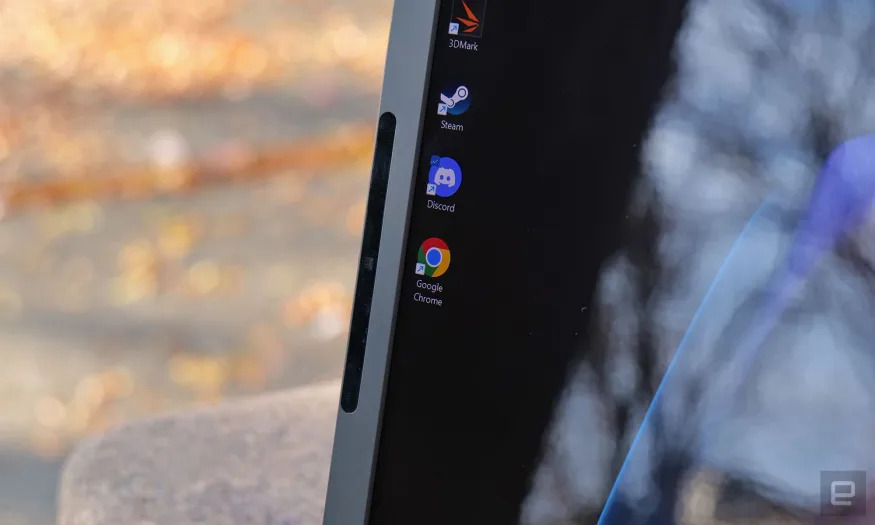
The one awkward thing about the Spectre Fold is that, while it has a sharp 5-MP webcam with support for Windows Hello, the orientation of the camera itself can be an issue depending on what mode the laptop is in. When set up as an all-in-one, the webcam is in portrait mode instead of landscape. And when you combine that with a sensor that’s located on the left bezel of its display, it can be difficult to frame yourself properly while keeping the laptop centered.
Performance
The Spectre Fold’s processor is the one part of its spec sheet that doesn’t feel quite as sophisticated. There’s only a single configuration that features an Intel Core i7-1250U chip along with 16GB of RAM and a 1TB SSD. This isn’t very impressive for a system this pricey, though HP says it chose that chip to ensure it would fit inside the Spectre Fold’s super thin chassis (just 0.33 inches unfolded). Regardless, for general productivity, this thing is speedy enough. Just don’t expect to do any sort of serious gaming or video editing.
Battery Life
Gallery: HP Spectre Fold review photos | 9 Photos
1/9
Typically on gadgets like this that are basically glorified concept devices, battery life is an afterthought. But the Spectre Fold defies those expectations with longevity that’s on par with more-traditional ultraportables. On PCMark10’s Open Office rundown test, it lasted 10 hours and 29 minutes, which is just 10 minutes shorter than the ASUS Zenbook S13’s time of 10:39. Though that was in laptop mode. With its 17-inch panel fully unfolded, battery life dropped by two hours to 8:31.
Wrap-up
A lot of people remain skeptical about gadgets with flexible displays (for good reason, I might add), but the $5,000 Spectre Fold is the best example yet of what this tech can offer. It’s a sleek machine that fits in tight spaces but also expands when you have more room to work. And when you need to pack up and go, it tucks away neatly in a bag. It gives you all the benefits of carrying around a portable monitor but with practically none of the drawbacks, while also addressing nearly every shortcoming from previous bendy attempts by Lenovo and ASUS.
Photo by Sam Rutherford/Engadget
However, putting a concrete score on something like this feels like it would be missing the point. Sure, it’s insanely expensive, but HP’s goal wasn’t to make something with mass appeal. The mission was to take the most advanced components and design principles available today to showcase the true potential of next-gen hybrid devices. And to that end, I think this device is a success. With the Spectre Fold, HP has made the first flexible-screen laptop you might want to buy. But now comes the hard part: making one that people can actually afford.
[…] Matter, version 1.2, is now available for device makers and platforms to build into their products. It is packed with nine new device types, revisions, and additions to existing categories, core improvements to the specification and SDK, and certification and testing tools. The Matter 1.2 certification program is now open and members expect to bring these enhancements and new device types to market later this year and into 2024 and beyond.
[…]
The new device types supported in Matter 1.2 include:
Refrigerators – Beyond basic temperature control and monitoring, this device type is also applicable to other related devices like deep freezers and even wine and kimchi fridges.
Room Air Conditioners – While HVAC and thermostats were already part of Matter 1.0, stand alone Room Air Conditioners with temperature and fan mode control are now supported.
Dishwashers – Basic functionality is included, like remote start and progress notifications. Dishwasher alarms are also supported, covering operational errors such as water supply and drain, temperature, and door lock errors.
Laundry Washers – Progress notifications, such as cycle completion, can be sent via Matter. Dryers will be supported in a future Matter release.
Robotic Vacuums – Beyond the basic features like remote start and progress notifications, there is support for key features like cleaning modes (dry vacuum vs wet mopping) and additional status details (brush status, error reporting, charging status).
Smoke & Carbon Monoxide Alarms – These alarms will support notifications and audio and visual alarm signaling. Additionally, there is support for alerts about battery status and end-of-life notifications. These alarms also support self-testing. Carbon monoxide alarms support concentration sensing, as an additional data point.
Air Quality Sensors – Supported sensors can capture and report on: PM1, PM 2.5, PM 10, CO2, NO2, VOC, CO, Ozone, Radon, and Formaldehyde. Furthermore, the addition of the Air Quality Cluster enables Matter devices to provide AQI information based on the device’s location.
Air Purifiers – Purifiers utilize the Air Quality Sensor device type to provide sensing information and also include functionality from other device types like Fans (required) and Thermostats (optional). Air purifiers also include consumable resource monitoring, enabling notifications on filter status (both HEPA and activated carbon filters are supported in 1.2).
Fans –Matter 1.2 includes support for fans as a separate, certifiable device type. Fans now support movements like rock/oscillation and new modes like natural wind and sleep wind. Additional enhancements include the ability to change the airflow direction (forward and reverse) and step commands to change the speed of airflow. […]
Core improvements to the Matter 1.2 specification include:
Latch & Bolt Door Locks – Enhancements for European markets that capture the common configuration of a combined latch and bolt lock unit.
Device Appearance – Added description of device appearance, so that devices can describe their color and finish. This will enable helpful representations of devices across clients.
Device & Endpoint Composition – Devices can now be hierarchically composed from complex endpoints allowing for accurate modeling of appliances, multi-unit switches, and multi-light fixtures.
Semantic Tags – Provide an interoperable way to describe the location and semantic functions of generic Matter clusters and endpoints to enable consistent rendering and application across the different clients. For example, semantic tags can be used to represent the location and function of each button on a multi-button remote control.
Generic Descriptions of Device Operational States – Expressing the different operational modes of a device in a generic way will make it easier to generate new device types in future revisions of Matter and ensure their basic support across various clients.
Under-the-Hood Enhancements: Matter SDK & Test Harness
Matter 1.2 brings important enhancements in the testing and certification program which helps companies bring products – hardware, software, chipsets and apps – to market faster. These improvements will benefit the wider developer community and ecosystem around Matter.
New Platform Support in SDK – Matter 1.2 SDK is now available for new platforms providing more ways for developers to build new products for Matter.
Enhancements to the Matter Test Harness – The Test Harness is a critical piece for ensuring the specification and its features are being implemented correctly. The Test Harness is now available via open source, making it easier for Matter developers to contribute to the tools (to make them better), and to ensure they are working with the latest version (with all features and bug fixes.
[…]
Developers interested in learning more about these enhancements can access the following resources:
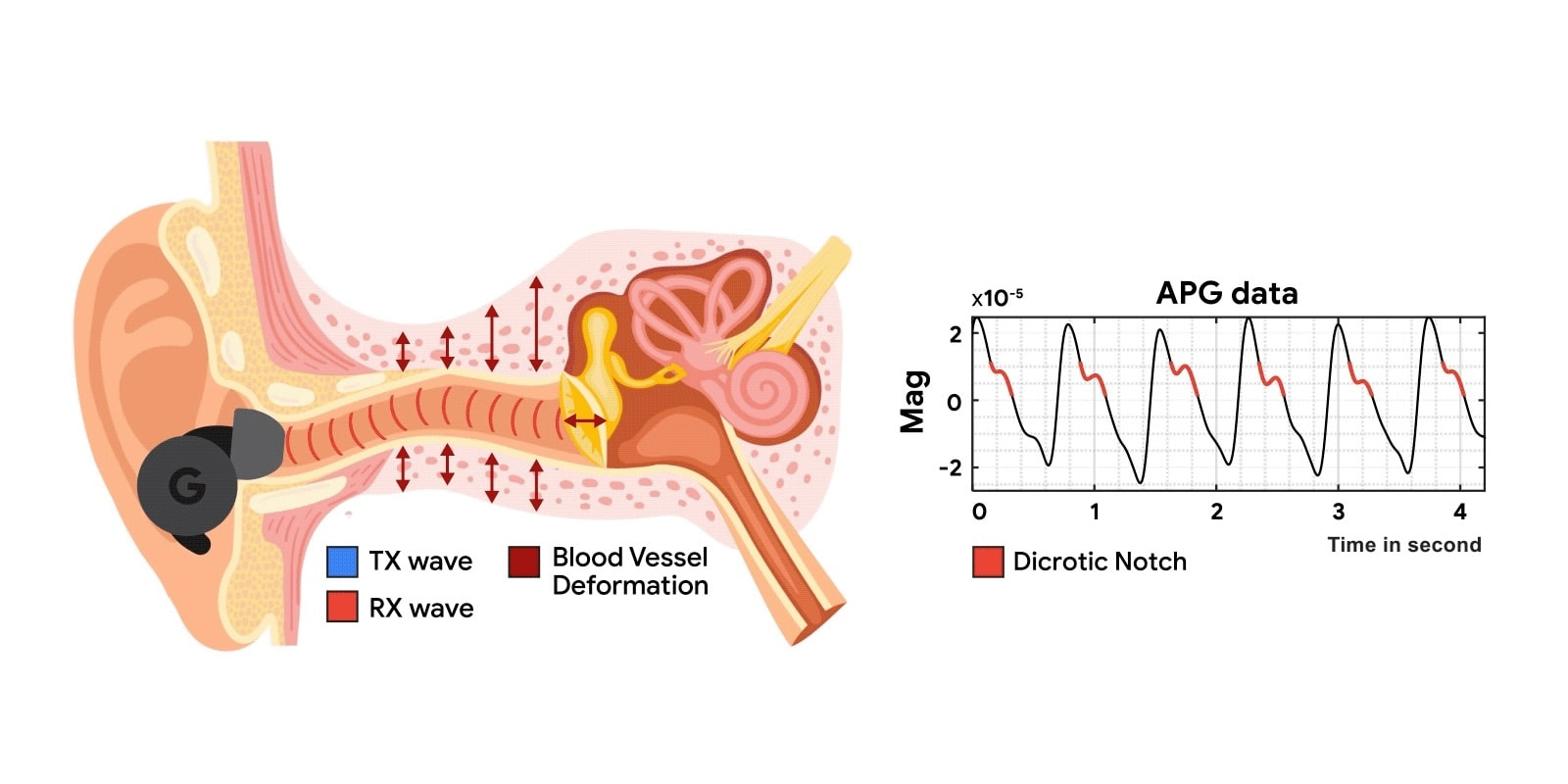
Google today detailed its research into audioplethysmography (APG) that adds heart rate sensing capabilities to active noise canceling (ANC) headphones and earbuds “with a simple software upgrade.”
Google says the “ear canal [is] an ideal location for health sensing” given that the deep ear artery “forms an intricate network of smaller vessels that extensively permeate the auditory canal.”
This audioplethysmography approach works by “sending a low intensity ultrasound probing signal through an ANC headphone’s speakers.”
This signal triggers echoes, which are received via on-board feedback microphones. We observe that the tiny ear canal skin displacement and heartbeat vibrations modulate these ultrasound echoes.
A model that Google created works to process that feedback into a heart rate reading, as well as heart rate variability (HRV) measurement. This technique works even with music playing and “bad earbuds seals.” However, it was impacted by body motion, and Google countered with a multi-tone approach that serves as a calibration tool to “find the best frequency that measures heart rate, and use only the best frequency to get high-quality pulse waveform.”
Google performed two sets of studies with 153 people that found APG “achieves consistently accurate heart rate (3.21% median error across participants in all activity scenarios) and heart rate variability (2.70% median error in inter-beat interval) measurements.”
Compared to existing HR sensors, it’s not impacted by skin tones. Ear canal size and “sub-optimal seal conditions” also do not impact accuracy. Google believes this is a better approach than putting traditional photoplethysmograms (PPG) and electrocardiograms (ECG) sensors, as well as a microcontroller, in headphones/earbuds:
…this sensor mounting paradigm inevitably adds cost, weight, power consumption, acoustic design complexity, and form factor challenges to hearables, constituting a strong barrier to its wide adoption.
Google closes on:
APG transforms any TWS ANC headphones into smart sensing headphones with a simple software upgrade, and works robustly across various user activities. The sensing carrier signal is completely inaudible and not impacted by music playing. More importantly, APG represents new knowledge in biomedical and mobile research and unlocks new possibilities for low-cost health sensing.
“APG is the result of collaboration across Google Health, product, UX and legal teams,” so this coming to Pixel Buds is far from guaranteed at this point.
Forget foldable phones, the next big trend could be gadgets that bend.
Lenovo, which is currently holding its ninth Tech World event in Austin, Texas, showed off its new collaboration with its subsidiary Motorola: a smartphone that can wrap around your wrist like a watch band.
It’s admittedly quite fascinating to see the tech in action. Lenovo calls its device the “Adaptive Display Concept”, which is comprised of a Full HD Plus resolution (2,228 x 1,080 pixels) pOLED screen that is able to “be bent and shaped into different” forms to meet the user’s needs. There’s no external hinge either as the prototype is a single-screen Android phone. The company explains bending it in half turns the 6.9-inch into one measuring 4.6 inches across. It can stand upright on the bent portion, in an arc, or wrap around a wrist as mentioned earlier.
Unfortunately, that’s all we know about the hardware itself. The Adaptive Display Concept did appear on stage at the Tech World 2023 where the presenter showed off its flexibility by placing it over her arm. Beyond that demonstration, though, both Lenovo and Motorola are keeping their lips sealed tight.
The Philips Hue ecosystem of home automation devices is “collapsing into stupidity,” writes Rachel Kroll, veteran sysadmin and former production engineer at Facebook. “Unfortunately, the idiot C-suite phenomenon has happened here too, and they have been slowly walking down the road to full-on enshittification.” From her blog post: I figured something was up a few years ago when their iOS app would block entry until you pushed an upgrade to the hub box. That kind of behavior would never fly with any product team that gives a damn about their users — want to control something, so you start up the app? Forget it, we are making you placate us first! How is that user-focused, you ask? It isn’t.
Their latest round of stupidity pops up a new EULA and forces you to take it or, again, you can’t access your stuff. But that’s just more unenforceable garbage, so who cares, right? Well, it’s getting worse.
It seems they are planning on dropping an update which will force you to log in. Yep, no longer will your stuff Just Work across the local network. Now it will have yet another garbage “cloud” “integration” involved, and they certainly will find a way to make things suck even worse for you. If you have just the lights and smart outlets, Kroll recommends deleting the units from the Hue Hub and adding them to an IKEA Dirigera hub. “It’ll run them just fine, and will also export them to HomeKit so that much will keep working as well.” That said, it’s not a perfect solution. You will lose motion sensor data, the light level, the temperature of that room, and the ability to set custom behaviors with those buttons.
“Also, there’s no guarantee that IKEA won’t hop on the train to sketchville and start screwing over their users as well,” adds Kroll.
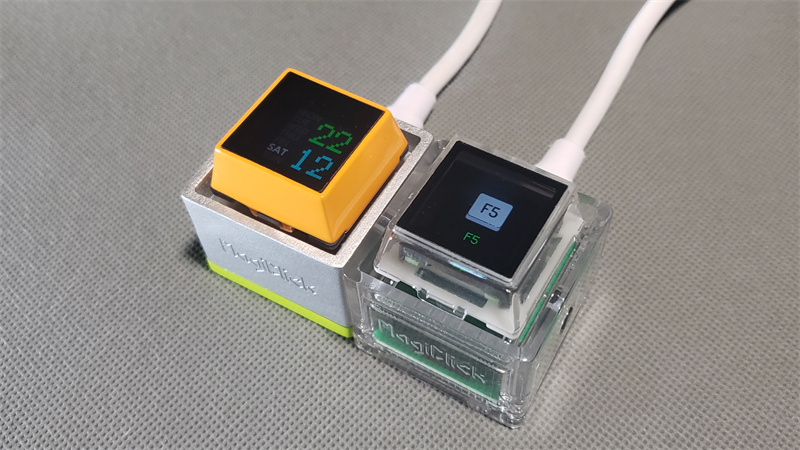
Well now why would I want a single-button keyboard, you might be asking yourself. We say it all depends on how you build the thing, and how you program it. Would you believe that the MagiClick by [Modular] is capable of showing live weather information or the date and time, acting as animated dice, or being a stopwatch and Pomodoro timer? Now you’re beginning to understand.
Before we get much further, yes, this bad boy has two additional buttons on the sides. But the spirit of the thing is in the single large switch in the middle. It’s hiding beneath the 0.85″ 128×128 display, which is protected from pressure and fingerprints by that Pop-o-Matic bubble over the top. While the big button is the main operator used to access the function options, the side buttons are used as auxiliaries to exit and return to the home screen.
MagiClick is based on the ESP32-S3 and is designed to run on CircuitPython. In addition to everything else packed into this thing, there are blinkenlights and a small speaker inside, plus a GPIO expansion header around back. Everything is available on GitHub if you want to build your own.
These Mymanu CLIK S are a pair of bluetooth earbuds that pair with an app on your phone to offer live translations of over 37 languages, including Spanish, German, French, Japanese, Arabic, Chinese, Finnish, Thai, Korean, and Japanese. The earbuds cost $157, and the app is included.
Obviously, these earbuds can be ideal for international travelers. They use an exclusive translation app called MyJuno, which is also where you can see the full list of translatable languages.
The CLIK S can translate for individual or group speakers, but only individual speakers get their translations played live in your earbud. You just select the relevant languages in the app, then hold the button on your earbud when you want to talk. A translation will be visible on your phone and will play audibly. When your conversation partner wants to talk, they just speak into your phone. For groups of speakers, the CLIK S will keep a written log of the conversation.
Fully charged, these earbuds can last for up to 10 hours, and the charging case can extend that to 30 hours. You can get the Mymanu CLIK S Translation Earbuds for $157, though prices can change at any time.
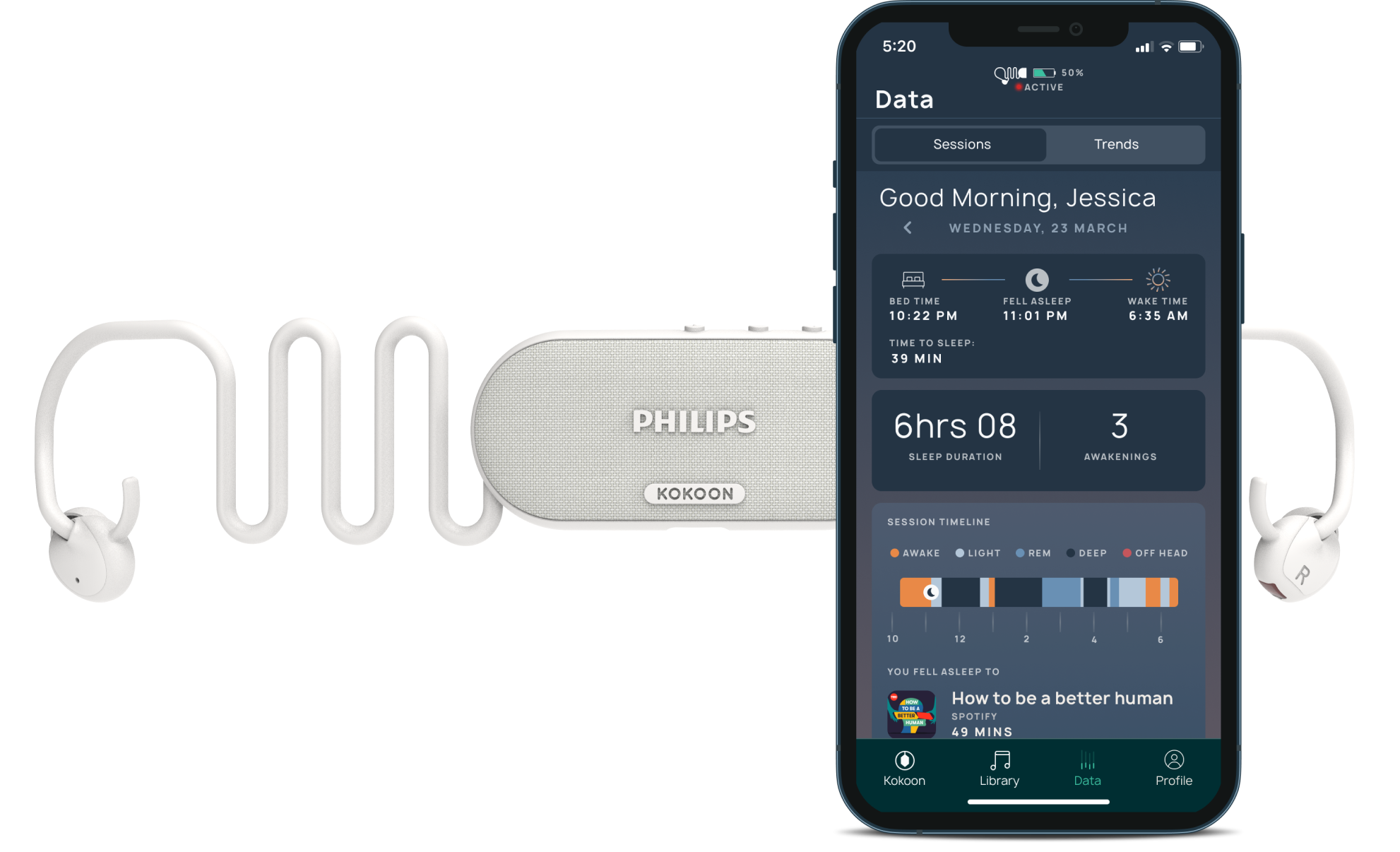
Philips and sleep specialists Kokoon have partnered to create an unparalleled sleep headphone.
The Philips Sleep Headphones, powered by Kokoon, blends sleep science and ergonomic know-how with Philips’ century-long reputation for crafting top-notch products.
[…]
Experience a comfort revolution. After numerous nights of testing, our team has crafted an earbud that flawlessly conforms to the shape of your ear for maximum comfort during side sleeping.
[…]
Sleep soundly with advanced biosensors that detect when you drift off and adjust sound levels accordingly, ensuring a peaceful and uninterrupted night.
[…]
Our biosensors introduce white noise during the night to assist with blocking out disruptive sounds such as snoring or external noise. Discover a more peaceful sleeping environment.
[…]
Get a better night’s sleep with sounds backed by science. Select from a variety of options including meditations, soundscapes, binaural beats, and more to ease into slumber.
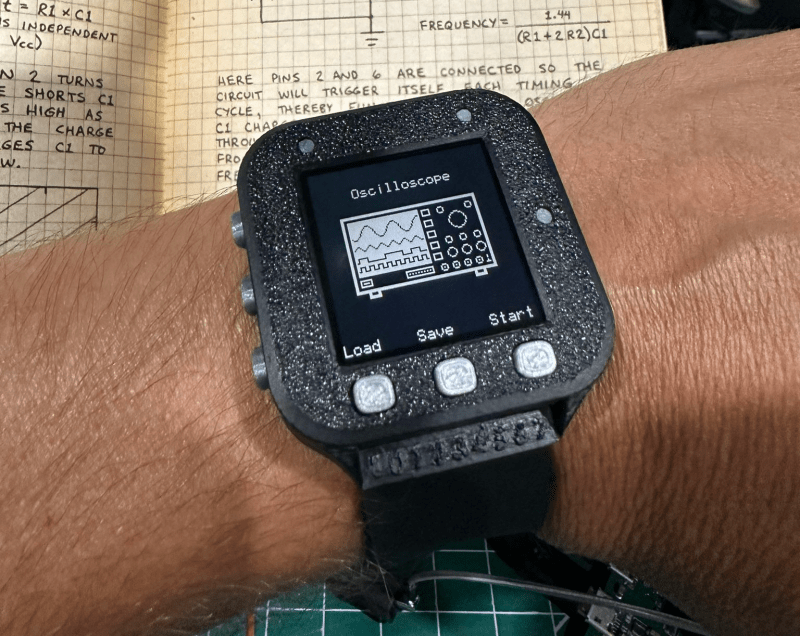
It may have taken ten years to come through on this particular Kickstarter, but a promise is a promise. In late August 2023, backers who had since likely forgotten all about the project started receiving their oscilloscope watches from creator [Gabriel Anzziani]. Whatever the reason(s) for the delay, the watch looks great, and is miles ahead of the prototype pictures.
As you may have guessed, it functions as both a watch and an oscilloscope. The watch has 12- and 24-hour modes as well as an alarm and calendar, and the ‘scope has all the features of the Xprotolab dev board, which [Gabriel] also created: ‘scope, waveform generator, logic analyzer, protocol sniffer, and frequency counter.
Internally, it has an 8-bit Xmega microcontroller which features an internal PDI, and the display is a 1.28″ e-ink display. When we covered this ten years ago, the screen was the type of Sharp LCD featured in the Pebble watch. [Gabriel]’s ‘scope watch features eight buttons around the edge which are user-programmable. One of [Gabriel]’s goals was for people to make their own apps.
Of course, the Kickstarter rewards are no longer available, but if you want to build your own small, digital ‘scope, check out this DIY STM32 project.
[…] an app is required to use many of the smart features of its bikes – and that app relies on communication with VanMoof servers. If the company goes under, and the servers go offline, that could leave ebike owners unable to even unlock their bikes
[…]
While unlocking is activated by Bluetooth when your phone comes into range of the bike, it relies on a rolling key code – and that function in turn relies on access to a VanMoof server. If the company goes bust, then no server, no key code generation, no unlock.
Rival ebike company Cowboy has a solution
A rival ebike company, Belgian company Cowboy, has stepped in to offer a solution. TNW reports that it has created an app which allows VanMoof owners to generate and save their own digital key, which can be used in place of one created by a VanMoof server.
If you have a VanMoof bike, grab the app now, as it requires an initial connection to the VanMoof server to fetch your current keycode. If the server goes offline, existing Bikey App users can continue to unlock their bikes, but it will no longer be possible for new users to activate it.
[…]
In some cases, a companion app may work perfectly well in standalone mode, but it’s surprising how often a server connection is required to access the full feature set.
[…]
Perhaps we need standards here. For example, requiring all functionality (bar firmware updates) to work without access to an external server.
Where this isn’t technically possible, perhaps there should be a legal requirement for essential software to be automatically open-sourced in the event of bankruptcy, so that there would be the option of techier owners banding together to host and maintain the server-side code?
Yup, there are too many examples of good hardware being turned into junk because the OEM goes bankrupt or just decides to stop supporting it. Something needs to be done about this.
f you’ve ever been riding your motorcycle and thought it’d be cool to have a Terminator-like head-up display, giving you vehicle and navigation data, BMW has just the thing for you. They’re called the BMW ConnectedRide Smartglasses—smart sunglasses with a head-up display (HUD) built into the right lens.
For a smart pair of glasses, with a HUD built in, they aren’t too clunky looking. They’re obviously a bit thicker than a normal pair of glasses but they look pretty sleek, all things considered. Admittedly, they don’t have a camera built in, like Google Glass, and they only need to house a small lithium-ion battery pack and a tiny HUD projector.
The display is pretty small but it’s surprisingly comprehensive. Its shows outside temperature, speed, speed limit, gear, and turn-by-turn navigation. With the latter, users can choose either a simplified arrow or a detailed navigation screen with street names and exact directions. According to BMW, a full battery charge will last ten hours, which is more than enough for a day’s worth of riding.
BMW says that these glasses can be made to fit a variety of different head and helmet shapes, which is said to make them comfortable enough to wear for a full day. The pair also comes with two different lenses. One of which is 85 percent transparent and is designed to be used with helmets that have tinted sun visors. While the other lens is tinted, turning these into sunglasses. Prescription lenses can be fitted via an optician with an RX adapter.
Photogrammetry is a 3D reconstruction technique using photographs of the target from multiple angles. Taking pictures around a static object with a single camera can yield high-quality models, but if the subject moves between images, 3D reconstruction might fail. One way to mitigate this is to use multiple cameras.
This project aimed to develop a tool for fast and precise wound documentation for clinical forensic medicine.
This paper describes a simple, low-cost modular system, where smartphones of different manufacturers are used as networked cameras. Exposure is initiated at the same time in all the phones with a simple circuit emulating a headset button press.
A proof-of-concept device was built, where four phones (Huawei nova 8i (2 pcs), Samsung Galaxy S7 Edge, Oukitel K4000 Pro) were attached to a curved, 3D-printed, handheld frame.
The average delay of image capture was 636 ms between the quickest and the slowest phones. When compared to the single-camera approach, the use of different cameras did not reduce the quality of the 3D model. The phone cam array was less susceptible to movement artefacts caused by breathing. Wound assessment was possible based on the 3D models created with this device.
In this paper, a simple, but modular 3D-printed frame is described. The phones are attached to a handheld, curved frame, which ensures that all the cameras would focus on the same point. The pieces are joined by heat-set inserts and metric screws. The 3D-printed phone mounts are attached with cable ties.
A simple modular system of Android phones to capture images concurrently for photogrammetry reconstruction.
The phones do not need to be the same model or make.
The phones are attached to a 3D-printed handheld frame.
The system allows the 3D reconstruction of living, moving subjects.
[…]
The core of the system is a simple controller module, which connects to the phone with a 3.5 mm jack plug and emulates the press of volume + of a headset, to release the camera shutter. The design is based on the Android Open Source Project (AOSP) accessory specification [23]
With 587 votes in favour, nine against and 20 abstentions, MEPs endorsed a deal reached with the Council to overhaul EU rules on batteries and waste batteries. The new law takes into account technological developments and future challenges in the sector and will cover the entire battery life cycle, from design to end-of-life.
Key measures foreseen by the regulation:
A compulsory carbon footprint declaration and label for electric vehicles (EV) batteries, light means of transport (LMT) batteries (e.g. for electric scooters and bikes), and rechargeable industrial batteries with a capacity above 2kWh;
Designing portable batteries in appliances in such a way that consumers can themselves easily remove and replace them;
A digital battery passport for LMT batteries, industrial batteries with a capacity above 2 kWh, and EV batteries;
A due diligence policy for all economic operators, except for SMEs;
Stricter waste collection targets: for portable batteries – 45% by 2023, 63% by 2027 and 73% by 2030; for LMT batteries – 51% by 2028 and 61% by 2031;
Minimum levels of materials recovered from waste batteries: lithium – 50% by 2027 and 80% by 2031; cobalt, copper, lead and nickel – 90% by 2027 and 95% by 2031;
Minimum levels of recycled content from manufacturing and consumer waste for use in new batteries: eight years after the entry into force of the regulation – 16% for cobalt, 85% for lead, 6% for lithium and 6% for nickel; 13 years after the entry into force: 26% for cobalt, 85% for lead, 12% for lithium and 15% for nickel.
Software engineer Jeff Lau, posting under the username UselessPickles, showed off the restored car phone in a video uploaded to YouTube. The Mitsubishi came from the factory with an optional “DiamondTel” handset and hands-free system, which was rendered inoperable by the discontinuation of analog “AMPS” cell service in the U.S. in 2008. (The 3G shutdown bricked a ton of newer cars’ connectivity features, too.)
After three years of work, Lau restored the device’s functionality using a custom Bluetooth adapter. Lau engineered the adapter to piggyback between the stock phone transceiver and hands-free control unit located under the trunk carpet. That let Lau tap into modern cell networks with his 1993 car phone—but he didn’t stop there.
Paired with a smartphone, the stock handset displays the name of the paired device and the signal strength of the smartphone’s network. It gets better: The car’s hands-free microphone feeds the smartphone voice commands (to Apple’s Siri in this case). It’s pretty much all the functionality of a 2023 hands-free system but without the distraction of a touchscreen.
Obviously, that isn’t about to become a widespread resto-mod trend soon. The lengthy dev time, low take rate of car phones in their day, and uniqueness of individual cars’ systems mean we’re probably not about to see off-the-shelf car phone restoration kits soon. But the fact that bringing car phones back is possible will hopefully inspire someone else out there to resuscitate theirs—maybe even one of those retro Chrysler VisorPhones will ride one day again. Or ring, I should say.
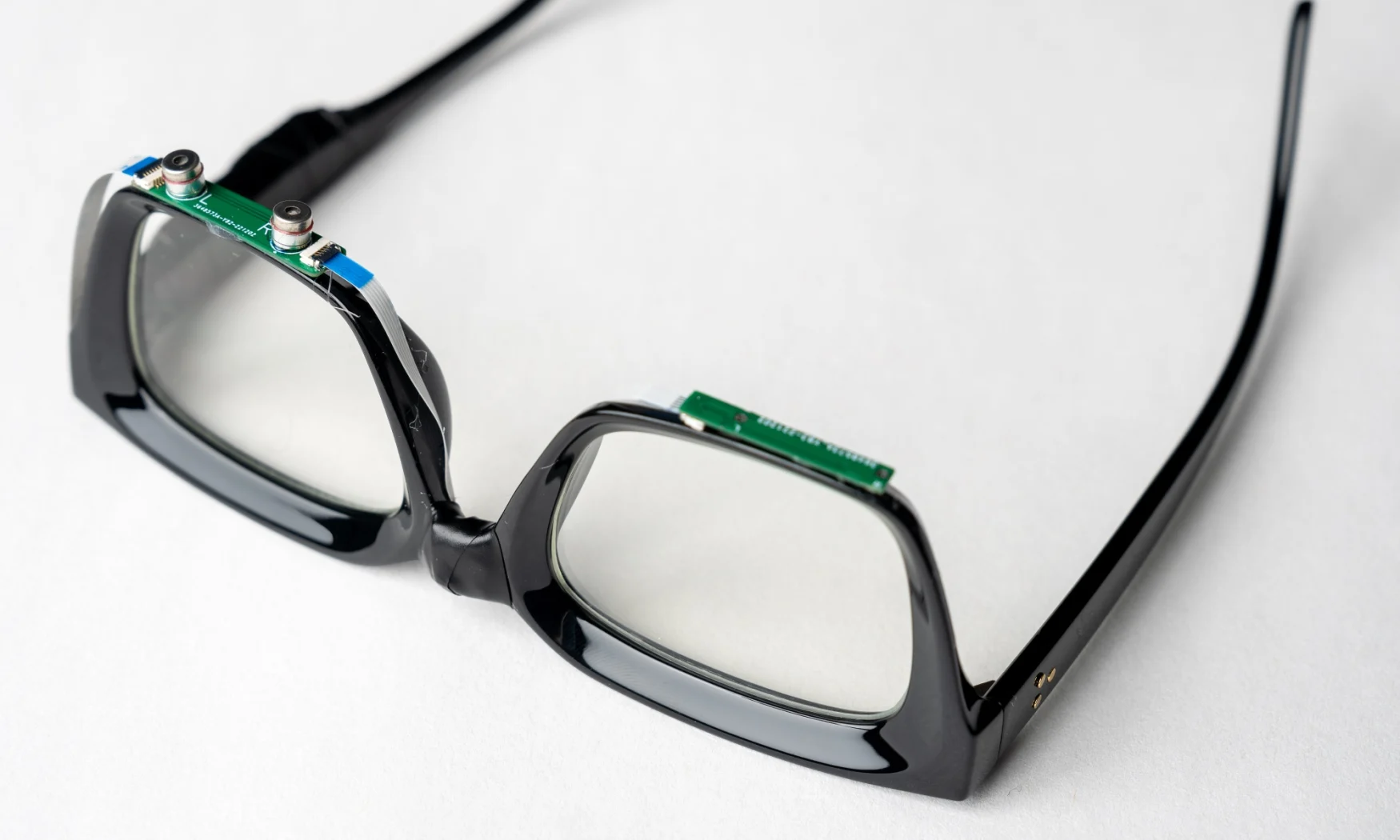
A Cornell University researcher has developed sonar glasses that “hear” you without speaking. The eyeglass attachment uses tiny microphones and speakers to read the words you mouth as you silently command it to pause or skip a music track, enter a passcode without touching your phone or work on CAD models without a keyboard.
Cornell Ph.D. student Ruidong Zhang developed the system, which builds off a similar project the team created using a wireless earbud — and models before that which relied on cameras. The glasses form factor removes the need to face a camera or put something in your ear. “Most technology in silent-speech recognition is limited to a select set of predetermined commands and requires the user to face or wear a camera, which is neither practical nor feasible,” said Cheng Zhang, Cornell assistant professor of information science. “We’re moving sonar onto the body.”
The researchers say the system only requires a few minutes of training data (for example, reading a series of numbers) to learn a user’s speech patterns. Then, once it’s ready to work, it sends and receives sound waves across your face, sensing mouth movements while using a deep learning algorithm to analyze echo profiles in real time “with about 95 percent accuracy.”
The system does this while offloading data processing (wirelessly) to your smartphone, allowing the accessory to remain small and unobtrusive. The current version offers around 10 hours of battery life for acoustic sensing. Additionally, no data leaves your phone, eliminating privacy concerns. “We’re very excited about this system because it really pushes the field forward on performance and privacy,” said Cheng Zhang. “It’s small, low-power and privacy-sensitive, which are all important features for deploying new, wearable technologies in the real world.”
The successor to the Recon Instruments Mod Live is here – the Rekkie AR ski goggles. They use a screen which reflects onto the plastic transparent goggle plate, so you can buy different types of lenses. The system shows maps, compass, speed, etc and is controlled by a large box on the strap which connects to the helmet, so in that respect not quite as elegant as the bluetooth remote of the Recon Mod system. The price is not bad at all at $349,-
The European Commission has adopted a new set of right to repair rules that, among other things, will add electronic devices like smartphones and tablets to a list of goods that must be built with repairability in mind.
The new rules [PDF] will need to be need to be negotiated between the European Parliament and member states before they can be turned into law. If they are, a lot more than just repairability requirements will change.
One provision will require companies selling consumer goods in the EU to offer repairs (as opposed to just replacing a damaged device) free of charge within a legal guarantee period unless it would be cheaper to replace a damaged item.
Note: so any company can get out of it quite easily.
Beyond that, the directive also adds a set of rights for device repairability outside of legal guarantee periods that the EC said will help make repair a better option than simply tossing a damaged product away.
Under the new post-guarantee period rule, companies that produce goods the EU defines as subject to repairability requirements (eg, appliances, commercial computer hardware, and soon cellphones and tablets) are obliged to repair such items for five to 10 years after purchase if a customer demands so, and the repair is possible.
[…]
The post-guarantee period repair rule also establishes the creation of an online “repair matchmaking platform” for EU consumers, and calls for the creation of a European repair standard that will “help consumers identify repairers who commit to a higher quality.”
[…]
New rules don’t do enough, say right to repair advocates
The Right to Repair coalition said in a statement that, while it welcomes the step forward taken by the EU’s new repairability rules, “the opportunity to make the right to repair universal is missed.”
While the EC’s rules focus on cutting down on waste by making products more easily repairable, they don’t do anything to address repair affordability or anti-repair practices, R2R said. Spare parts and repair charges, the group argues, could still be exorbitantly priced and inaccessible to the average consumer.
[…]
Ganapini said that truly universal right to repair laws would include assurances that independent providers were available to conduct repairs, and that components, manuals and diagnostic tools would be affordably priced. She also said that, even with the addition of smartphones and tablets to repairability requirements, the products it applies to is still too narrow.
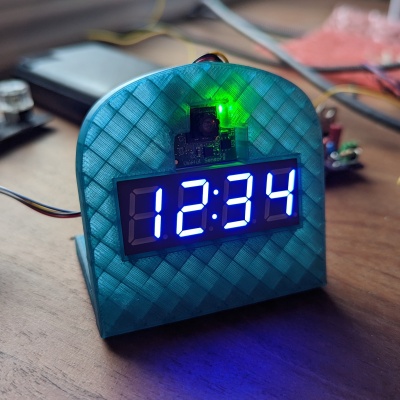
We have a soft spot for devices that subvert purpose and expectation, and that definitely sums up [Guy Dupont]’s Clock That Is Wrong. It knows the correct time, but whether or not it displays the correct time is another story. That’s because nestled just above the 7-segment display is a person sensor module, and when it detects that a person is looking towards it, the clock will display an incorrect time, therefore self-defeating both the purpose and primary use case of a clock in one stroke.
One interesting bit is that [Guy] uses an ESP32-based board to drive everything, but had some reservations about making a clock without an RTC. However, he found that simply syncing time over the network every 10 minutes or so using the board’s built-in WiFi was perfectly serviceable, at least for a device like this.
This reminds us a little of other clocks with subtly subversive elements, like the Vetinari Clock which keeps overall accurate time despite irregularly drifting in and out of sync. Intrigued by such ideas? You’re not alone, because there are even DIY hobby options for non-standard clock movements.
[…] Here, guided by nucleation thermodynamics, we design a transparent, sunlight-activated, photothermal coating to inhibit fogging. The metamaterial coating contains a nanoscopically thin percolating gold layer and is most absorptive in the near-infrared range, where half of the sunlight energy resides, thus maintaining visible transparency. The photoinduced heating effect enables sustained and superior fog prevention (4-fold improvement) and removal (3-fold improvement) compared with uncoated samples, and overall impressive performance, indoors and outdoors, even under cloudy conditions. The extreme thinness (~10 nm) of the coating—which can be produced by standard, readily scalable fabrication processes—enables integration beneath other coatings […]
he Boston Globe reports that U.S. Senator Ed. Markey just sent a letter to more than 20 car manufacturers asking them to continue including AM radios in future car models — including electric vehicles: Some EV manufacturers have raised concerns even as far back as 2016 about how the battery power of an EV can interfere with AM radio signals. However, Markey addressed these concerns saying, “car manufacturers appear to have developed innovative solutions to this problem.”
“The last time I listened to AM radio was in the late 1970s,” writes long-time Slashdot reader non-e-moose. “And then it was mostly because there were either no FM stations in reception range, or I was riding my bicycle and only had a transistor radio.”
But the Senator sees it differently: AM radio has long been an important source of information for consumers. Before the COVID-19 pandemic, nearly 90 percent of Americans ages 12 and older — totaling hundreds of millions of people — listened to AM or FM radio each week, higher than the percentage that watch television (56 percent) or own a computer (77 percent)…. Moreover, 33 percent of new car buyers say that AM radio is a very important feature in a vehicle — higher than dedicated Wi-Fi (31 percent), SiriusXM satellite radio (27 percent), and personal assistants such as Google Assistant (12 percent) and Amazon Alexa (9 percent). In other words, broadcast AM and FM radio remain an essential vehicle feature for consumers.
Moreover, broadcast AM radio, in particular, is a critical mechanism for government authorities to communicate with the public during natural disasters, extreme weather events, and other emergencies. AM radio operates at lower frequencies and has longer wavelengths than FM radio, so AM radio waves more easily pass through solid objects. As a result, AM radio signals can travel long distances, making them well-suited for broadcasting emergency alerts….
Despite innovations such as the smartphone and social media, AM/FM broadcast radio remains the most dependable, cost-free, and accessible communication mechanism for public officials to communicate with the public during times of emergency. As a result, any phase-out of broadcast AM radio could pose a significant communication problem during emergencies…. Given AM radio’s importance for emergency communications and continued consumer demand, I urge your company to maintain the feature in its new vehicles…

There’s a lot of variety in his designs, and while it’s all fantastic from beginning to end, two things stood out to us as being of particular interest. One is the “Plus Box” which makes a clicking sound when the pieces are moved (at 2:47) thanks to a clever wooden spring. [Kagen] shows an example of the concept, where a flat wood piece with slots cut from the sides acts as a spring and clicks into notches when moved, providing audible and tactile feedback without anything other than wood.